Social networks around the Orońsko flint mining area (Central-Southern Poland) during the Late Palaeolithic
The first results of the SEM-EDS analysis of flints and pigments
DOI:
https://doi.org/10.35686/AR.2025.261Keywords:
chocolate flint, pigment, ochre, mine, Palaeolithic, Orońsko, SEM-EDSAbstract
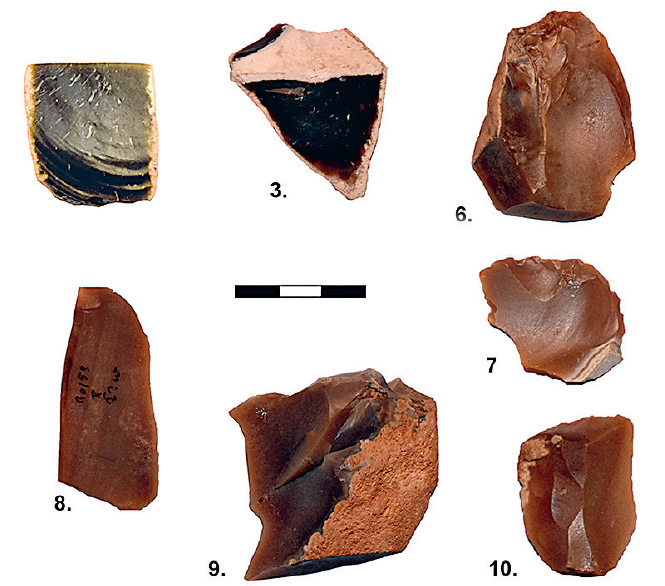
Orońsko site 2 is a Palaeolithic shaft mine located in the area of chocolate flint deposits in Central-Southern Poland. This raw material was highly valued by Stone Age communities and widely distributed during the Late Palaeolithic. The mine is associated with the Arch-Backed Pieces (Federmesser) and Tanged Point Technocomplexes. This article aims to explore the connections between artefacts made of chocolate flint found at various Late Palaeolithic sites located outside the chocolate flint deposits (Całowanie and ochre quarry at Rydno) with the Orońsko mine and to investigate a possible connection between the ochre found in the Orońsko mining shaft with the Rydno quarry. Macroscopic and SEM-EDS analyses were conducted on selected samples of these raw materials and artefacts from the Orońsko mine, the Orońsko workshop, Rydno, and Całowanie, all of which can be chronologically linked to one another. The results suggest that some of the flint may have been transported from the Orońsko mining area to Rydno or Całowanie. However, the reverse transport of ochre from Rydno to Orońsko remains unclear and requires further research, including a broader range of analytical methods.
Downloads
References
Brandl, M. – Hauzenberger, C. – Martinez, M. M. – Filzmoser, P. – Werra, D. H. 2016: The Ap-plication of the Multi- Layered Chert Sourcing Approach (MLA) for the Characterisation and Dif-ferentiation of ‘Chocolate Silicites’ from the Holy Cross Mountains, South-Central Poland. Ar-chaeologia Austriaca 100, 119–150. DOI: https://doi.org/10.1553/archaeologia100s119
Budziszewski, J. 2008: Stan badań nad występowaniem i pradziejową eksploatacją krzemieni czekoladowych. In: W. Borkowski – J. Libera – B. Sałacińska – S. Sałaciński (eds.), Krzemień czekoladowy w pradziejach. Materiały z konferencji w Orońsku, 08–10.10.2003. Studia nad gos-podarką surowcami krzemiennymi w pradziejach 7. Warszawa–Lublin: Państwowe Muzeum Ar-cheologiczne, 33–106.
Chmielewska, M. 1988: The early Bronze age flint mine at site II, Polany, Radom district. Prze-gląd Archeologiczny 35, 139–181.
Fiers, G. – Halbrucker, E. – Kock De, T – Laforce, B. – Vandendriessche, H. – Messiaen, L. – Vin-cze, L. – Crombe, P. – Cnudde, V. 2019: Preliminary characterization of flint raw material used on prehistoric sites in NW Belgium. Geoarchaeology 34, 400–412. DOI: https://doi.org/10.1002/gea.21719
Grafka, O. – Werra, D. H. – Siuda, R. 2015: Analysis of Organic Compounds: Applications in Ar-chaeology and Earth Science. Litikum 3, 26–37. DOI: https://doi.org/10.23898/litikuma0010
Gutowski, J. 1998: Oxfordian and Kimmeridgian of the northeastern margin of the Holy Cross Mountains, Central Poland. Geological Quarterly 42, 59–72.
Hensel, Z. 2011: Physical and chemical examination of hematite gravel from Rydno quarry. In: R. Schild – H. Królik – A. J. Tomaszewski – E. Ciepielewska (eds.), Rydno, a Stone Age red ochre quarry and socioeconomic center. A century of research. Warszawa: Instytut Archeologii I Etnologii Polskiej Akademii Nauk, 405–408.
Herbich T. – Lech J. 1995: PL 5 Polany II, Radom Province. Archaeologia Polona 33, 488–506.
Högberg A. – Olausson D. – Hughes, R. 2012: Many Different Types of Scandinavian Flint: Visual Classification and Energy Dispersive X-ray Fluorescence. Fornvännen 107, 225–240.
Hughes, R. E. – Baltrûnas, V. – Kulbickas, D. 2011: Comparison of two analytical methods for the chemical characterization of flint from Lithuania and Belarus. Geologija 53, 69–74. DOI: https://doi.org/10.6001/geologija.v53i2.1850
Hughes, R. E. – Högberg, A. – Olausson, D. 2010: Sourcing flint from Sweden and Denmark. A pilot study employing non-destructive energy dispersive X-ray fluorescence spectrometry. Journal of Nordic Archaeological Science 17, 15–25.
Hughes, R. – Werra, D. H – Siuda, R. 2016: On the Chemical Composition of 'Chocolate' Flint from Central Poland. Archaeologia Polona 54, 99–114.
Kerneder-Gubała 2019: In search of the chocolate flint mine in Orońsko (PL1, Southern Poland): New data for analysis of exploitation and use of flint in north-western part of its outcrops. An-thropologica et Præhistorica 128, 199–208.
Kozłowski, S. K. 2008: Legenda Orońska. In: W. Borkowski – J. Libera – B. Sałacińska – S. Sałaciński (eds.), Krzemień czekoladowy w pradziejach. Materiały z konferencji w Orońsku, 08–10.10.2003. Studia nad gospodarką surowcami krzemiennymi w pradziejach 7. Warszawa – Lu-blin: Państwowe Muzeum Archeologiczne, 25–32.
Krajcarz, M. T. – Krajcarz, M. – Sudoł, M. – Cyrek, K. 2012: From far of from near? Sources of Kraków-Częstochowa banded and chocolate silicate raw material used during the stone age in Biśnik Cave (Southern Poland). Anthropologie 50, 411–425.
Krukowski, S. 1922: Pierwociny krzemieniarskie górnictwa, transportu i handlu w holocenie Pol-ski, cz. II. Wiadomości Archeologiczne 7, 34–57.
Krukowski, S. 1923: Sprawozdania z działalności Państwowego Konserwatora Zabytków Prahisto-rycznych na okręg kielecki na rok 1922. Wiadomości Archeologiczne 8, 69–70.
Krukowski, S. 1939–1948: Paleolit. In: Encyklopedia polska PAU. Prehistoria ziem polskich 4. Kraków: Polska Akademia Umiejetności, 1–117.
Lech, H. – Lech J. 1984: The prehistoric flint mine at Wierzbica ʻZeleʼ: a case study from Poland. World Archaeology 16, 190–208. DOI: https://doi.org/10.1080/00438243.1984.9979927
Lech, J. – Werra, D. H. 2019: The flint mine site Wierzbica ʻZeleʼ (Poland) and Bronze Age work-shop materials after forty years of new research (1979–2018). Anthropologica et Præhistorica 128, 85–100.
Mandera, S. – Sudoł-Procyk, M. – Malak, M. – Skrzatek, M. – Krajcarz, M. T. 2024: New deposit of chocolate flint in Załęże gully (Kraków-Częstochowa Upland, Poland) – Raw material charac-terization and its availability for prehistoric communities. Journal of Archaeological Science: Re-ports 53, 104328. DOI: https://doi.org/10.1016/j.jasrep.2023.104328
Matyszkiewicz, J. – Kochman, A. 2020: The provenance of siliceous rocks from the Kraków-Częstochowa Upland (Poland) used as raw-materials in the manufacture of siliceous artefacts from Central-Eastern Europe; An old problem in new light. Journal of Archaeological Science: Reports 34, 102600. DOI: https://doi.org/10.1016/j.jasrep.2020.102600
Osipowicz, G. – Kerneder-Gubała, K. – Bosiak, M. – Makowiecki, D. – Orłowska, J. 2019: The oldest osseous mining tools in Europe? New discoveries from the chocolate flint mine in Orońsko, site 2 (southern Poland). Quaternary International 512, 82–98. DOI: https://doi.org/10.1016/j.quaint.2019.02.005
Parish, R. M. – Werra, D. H. 2018: Characterizing “Chocolate” Flint Using Reflectance Spectros-copy. Archaeologia Polona 56, 89–101. DOI: https://doi.org/10.23858/APa56.2018.007
Přichystal, A. 2013: Lithic Raw Materials in Prehistoric Times of Eastern Central Europe. Brno: Masaryk University Press.
Roldan, C. – Carballo, J. – Murcia, S. – Eixea, A. – Villaverde, V. – Zilhao, J. 2015: Identification of local and allochtonous flint artefacts from the Middle Palaeolithical site ‘Abrigo de la Quebra-da’ (Cherva, Valencia, Spain) by macroscopic and physicochemical methods. X-Ray Spectrom 44, 209–216. DOI: https://doi.org/10.1002/xrs.2602
Samsonowicz, J. 1923: O złożach krzemieni w utworach jurajskich północno-wschodniego zbocza Gór Świętokrzyskich. Wiadomości Archeologiczne 8, 17–24.
Schild, R. 1971: Lokalizacja prahistorycznych punktów eksploatacji krzemienia czekoladowego na północnowschodnim obrzeżeniu Gór Świętokrzyskich. Folia Quaternaria 39, 1–61.
Schild, R. 1976: Flint mining and trade in Polish prehistory as seen from the perspective of the chocolate flint of central Poland. A second approach. Acta Archaeologica Carpathica 16, 147–177.
Schild, R., 1995a: PL 2 Tomaszów I, Radom Province. Archaeologia Polona 33, 455–465.
Schild, R., 1995b: PL 4 Polany Kolonie II, Radom Province. Archaeologia Polona 33, 480–488.
Schild, R. (ed.) 2014: Całowanie. A Final Paleolithic and Early Mesolithic Site on an Island in the ancient Vistula channel. Warszawa: Instytut Archeologii i Etnologii Polskiej Akademii Nauk.
Schild, R. – Królik, H. – Marczak, M. – Mościbrodzka, J. – Hensel W. 1981: Rydno: a final Paleo-lithic ochre mining complex. Przegląd Archeologiczny 29, 53–100.
Schild, R. – Królik, H. – Mościbrodzka, J. 1977: Kopalnia krzemienia czekoladowego z przełomu neolitu i epoki brązu w Polanach Koloniach. Wrocław – Warszawa – Kraków: Zakład Narodowy im. Ossolińskich.
Schild, R. – Królik, H. – Marczak, M. 1985: Kopalnia krzemienia czekoladowego w Tomaszowie. Wrocław – Warszawa – Kraków: Zakład Narodowy im. Ossolińskich.
Schild R. – Królik H. – Tomaszewski A. J. – Ciepielewska E. 2011: Rydno. A Stone Age red ochre quarry and socioeconomic center. A century of research. Warsaw: Instytut Archeologii i Etnologii Polskiej Akademii Nauk.
Sobkowiak-Tabaka, I. – Werra, D. H. – Hughes, R. E. – Siuda, R. 2016: Erratic Flint from Poland: Preliminary results of petrographic and geochemical analyses. Archaeologia Polona 54, 67–82.
Sudoł-Procyk, M. 2022: One century of studies on chocolate flint. And what do we really know about it ...? Sprawozdania Archeologiczne 74, 49–65. DOI: https://doi.org/10.23858/SA/74.2022.1.3012
Sudoł-Procyk, M. – Budziszewski, J. – Krajcarz, M. – Jakubczak, M. – Szubski, M. 2018: The Chocolate Flint Mines in the Udorka Valley (Częstochowa Upland) – a Preliminary Report on the Field and Lidar Surveys. In: D. H. Werra – M. Woźny (eds.), Between History and Archaeology: Papers in honour of Jacek Lech. Oxford: Archaeopress, 89–102. DOI: https://doi.org/10.2307/j.ctvndv6qh.13
Sulgostowska, Z. 2005: Kontakty społeczności późnopaleolitycznych i mezolitycznych między Odrą, Dźwiną i Górnym Dniestrem. Warszawa: Instytut Archeologii i Etnologii Polskiej Akademii Nauk.
Sulgostowska, Z. 2008: Szczególna pozycja krzemienia czekoladowego wśród społeczności między Odrą, Dźwiną i Dniestrem u schyłku paleolitu i w późnym mezolicie. In: W. Borkowski – J. Libera – B. Sałacińska – S. Sałaciński (eds.), Krzemień czekoladowy w pradziejach. Materiały z konferencji w Orońsku, 08–10.10.2003. Studia nad gospodarką surowcami krzemiennymi w pra-dziejach 7. Warszawa – Lublin: Państwowe Muzeum Archeologiczne, 151–170.
Tomaszewski A. J. – Królik H. – Ciepielewska E. – Mańka D. 2008: Kto inny, kiedy indziej, na drugim brzegu… Różnice w wykorzystywaniu krzemienia czekoladowego w niektórych zespołach późnopaleolitycznych na Rydnie, In: W. Borkowski – J. Libera – B. Sałacińska – S. Sałaciński (eds.), Krzemień czekoladowy w pradziejach. Materiały z konferencji w Orońsku, 08–10.10.2003. Studia nad gospodarką surowcami krzemiennymi w pradziejach 7. Warszawa – Lublin, 379–397.
Velliky E. C. – MacDonald B. L. M. – Porr M. – Conard N. J. 2021: First large-scale provenance study of pigments reveals new complex behavioural patterns during the Upper Palaeolithic of south-west Germany. Archaeometry 63, 173–193. DOI: https://doi.org/10.1111/arcm.12611
Weinstein-Evron M. – Ilani S. 1994: Provenance of ochre in the Natufian layers of el-Wad cave, Mount Carmel, Israel. Journal of Archaeological Sciences 2, 461–467. DOI: https://doi.org/10.1006/jasc.1994.1045
Werra, D. H. – Kerneder-Gubała, K. 2021: ‘Chocolate’ flint mining from Final Palaeolithic up to Early Iron Age – a review. In: F. Bostyn – F. Giligny – P. Topping (eds), From Mine to User: Pro-duction and Procurement Systems of Siliceous Rocks in the European Neolithic and Bronze Age. Proceedings of the XVIII UISPP World Congress (4–9 June 2018, Paris, France). Volume 10. Ses-sion XXXIII-1&2. Oxford: Archaeopress Archaeology, 42–56. DOI: https://doi.org/10.2307/jj.15136049.9
Werra, D. H. – Siuda R. 2015: The mineral composition of ‘chocolate’ flint compared to other varieties of chert from Central and Southern Poland used by prehistoric communities. In: X. Man-gado – O. Crandell – M. Sánchez – M. Cubero (eds), International Symposium on Knappable Ma-terials ‘On the Rocks’. Barcelona 7–11 September 2015. Abstracts 128. Barcelona: University of Barcelona.
Werra, D. H – Siuda, R. 2022: The use of phosphate minerals for determination of the provenance of flint used by prehistoric communities in East-Central Europe. Quaternary International 615, 5–17. DOI: https://doi.org/10.1016/j.quaint.2021.04.028
Werra, D. H – Siuda R. – Grafka O. – Segit T. 2015: Pierwsze próby charakterystyki geochem-icznej i palinologicznej krzemienia „czekoladowego” z kopalni Wierzbica „Zele”, pow. Ra-dom. Acta Universitatis Nicolai Copernici, Archaeologia 34, 249–270. DOI: https://doi.org/10.12775/AUNC_ARCH.2015.011
Downloads
Published
How to Cite
Issue
Section
Categories
License
Copyright (c) 2025 Katarzyna Kerneder-Gubała, Julia Kościuk-Załupka, Dominik Gurba, Mateusz Słoniewski

This work is licensed under a Creative Commons Attribution 4.0 International License.