Sídelní a časová dynamika během LBK a post-LBK přechodu
Studie sprašového koridoru od Porýní po Hesbaye (Německo, Nizozemsko, Belgie)
DOI:
https://doi.org/10.35686/AR.2026.354Klíčová slova:
neolit, kultura s lineární keramikou (LBK), post-LBK, severozápadní Evropa, bayesovské chronologické modelování, sídelní dynamikaAbstrakt
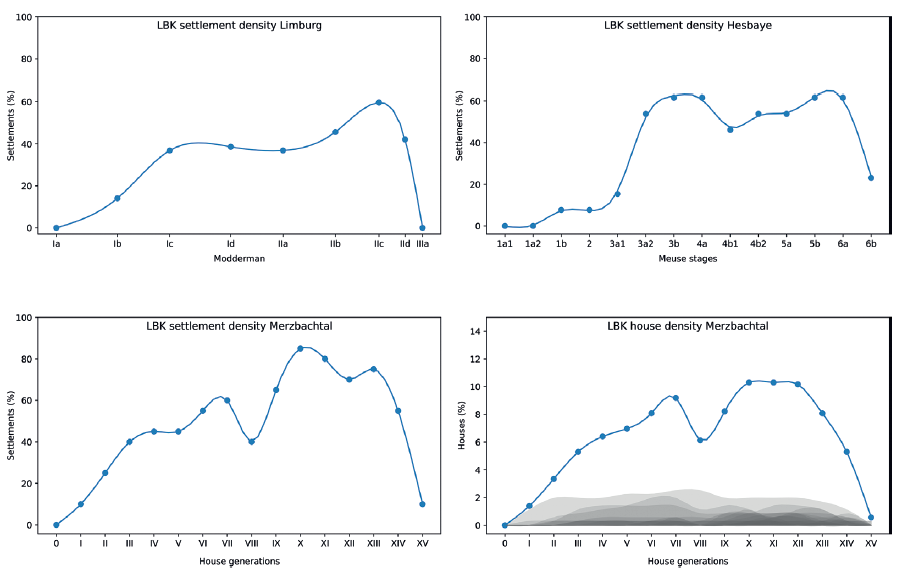
Tato studie se zabývá sídelní dynamikou komunit kultury s lineární keramikou (LBK) a post-LBK období ve sprašovém koridoru zahrnujícím Porýní, Limburg a Hesbaye (Německo, Nizozemsko a Belgie). Pomocí bayesovského chronologického modelování radiokarbonových dat a regionálních keramických typochronologií nově posuzujeme načasování a tempo expanze LBK, populačního růstu a následného přechodu k post-LBK období. S ohledem na obtíže vyplývající z omezeného množství dat představujeme dva alternativní modely: první upřednostňuje existující typochronologické rámce, zatímco druhý klade důraz na aktuálně dostupná radiokarbonová data. Výsledky ukazují rychlý počáteční nárůst hustoty osídlení LBK, po němž následovala fáze intenzifikace spojená s výstavbou ohrazení v polovině 51. století př. n. l. Přechod k post-LBK období byl heterogenní a vyznačoval se regionálními rozdíly v kontinuitě a opouštění sídel. Tato zjištění přispívají k širší diskusi o expanzi, sociální dynamice a interakcích raně zemědělských komunit se životním prostředím v severozápadní Evropě. Zároveň poukazují na potenciál absolutního datování i na potřebu věnovat mu znovu větší pozornost.
Stažení
Reference
Amkreutz, L. 2013: Persistent Traditions: A Long-Term Perspective on Communities in the Process of Neolithisation in the Lower Rhine Area (5500–2500 cal BC). Leiden: Sidestone Press.
Amkreutz, L. 2016: It’s better to burn out than to fade away: A comparative perspective on the diversity in LBK endings in the Rhine-Meuse region. In: L. Amkreutz – F. Haack – D. Hofmann – I. van Wijk (eds.), Something out of the ordinary? Interpreting diversity in the Early Neolithic Linearbandkeramik and beyond. Newcastle upon Tyne: Cambridge Scholars Publishing, 357–397.
Amkreutz, L. 2017: A world ends: The demise of the northwestern Bandkeramik. Analecta Praehistorica Leidensia: Excerpta Archaeologica Leidensia II, 47, 19–35.
Bakels, C. C. 1992: The botanical shadow of two early Neolithic settlements in Belgium: Carbonized seeds and disturbances in the pollen record. Review of Palaeobotany and Palynology 73, 1–19. DOI: https://doi.org/10.1016/0034-6667(92)90041-E
Bakels, C. C. 2021: De vegetatiegeschiedenis van Sittard aan de hand van een pollendiagram. Natuurhistorisch Maandblad 110(7), 165–172.
Balkowski, N. 2015: From Merzbachtal to the Graetheide? Mobility at the end of the Linear Pottery Culture. In: S. Scharl – B. Gehlen (eds.), Mobility in Prehistoric Sedentary Societies: Papers of the CRC 806 Workshop in Cologne 26–27 June 2015. Kölner Studien zur Prähistorischen Archäologie 8. Rahden: Verlag Marie Leidorf, 119–128.
Balkowski, N. – Hartmann, S. 2015: Vom Merzbachtal in die Graetheide? Die Synchronisation der niederländischen Bandkeramik mit der Aldenhovener Platte am Beispiel der Siedlung und des Gräberfeldes von Elsloo. Archäologische Informationen 38, 531–542.
Balkowski, N. – Classen, E. – Peters, R. 2016: The older LBK site of Niederkassel-Uckendorf revisited. In: T. Kerig – K. Nowak – G. Roth (eds.), Alles was zählt...: Festschrift für Andreas Zimmermann. Bonn: Rudolf Habelt, 79–92.
Balkowski, N. 2024: Chronologie und Siedlungsstruktur des Fundplatzes. In: N. Balkowski – R. Peters (eds.), Der bandkeramische Fundplatz Arnoldsweiler-Ellebach (Band 1). Rheinische Ausgrabungen 85/1. Bonn: LVR-Amt für Bodendenkmalpflege im Rheinland, 43–135.
Bayliss, A. 2015: Quality in Bayesian chronological models in archaeology. World Archaeology 47, 677–700. DOI: https://doi.org/10.1080/00438243.2015.1067640
Bayliss, A. – van der Plicht, J. – Bronk Ramsey, C. – McCormac, G. – Healy, F. – Whittle, A. 2011: Towards generational time-scales: the quantitative interpretation of archaeological chronologies. In: A. Whittle – F. Healy – A. Bayliss (eds.), Gathering time: Dating the Early Neolithic enclosure of Southern Britain and Ireland. Oxford: Oxbow Books, 17–59. DOI: https://doi.org/10.2307/j.ctvh1dwp2.13
Blouet, V. – Bosquet, D. – Constantin, C. – Fock, H. – Ilett, M. – Jadin, I. – Klag, T. – Petitdidier, M.-P. – Thomashausen, L. 2021: Le Rubané en Belgique: nouvelle chronologie céramique et synchronisation avec les régions voisines. Bulletin de la Société préhistorique française 118, 277–322. DOI: https://doi.org/10.3406/bspf.2021.15199
Blouet, V. – Klag, T. – Petitdidier, M.-P. – Thomashausen, L. 2013: Le Néolithique ancien en Lorraine: Inventaire des sites et planches céramique. Mémoire 55. Paris: La Société Préhistorique Française.
Boelicke, U. 1982: Gruben und Häuser: Untersuchungen zur Struktur bandkeramischer Hofplätze. In: B. Chropovský – J. Pavúk (eds.), Siedlungen der Kultur mit Linearkeramik in Europa. Internationales Kolloquium Nové Vozokany 17.–20. November 1981. Nitra: Archäologisches Institut der Slowakischen Akademie der Wissenschaften, 17–28.
Bocquet-Appel, J.-P. – Dubouloz, J. – Moussa, R. – Berger, J.-F. et al.2015: Multi-agent Modelling of the Trajectory of the LBK Neolithic. In: F. Giligny – F. Djindjian – L. Costa –P. Moscati – S. Robert (eds.), CAA2014: 21st Century Archaeology: Concepts, methods and tools. Proceedings of the 42nd Annual Conference on Computer Applications and Quantitative Methods in Archaeology, Oxford: Archaeopress, 611–622. DOI: https://doi.org/10.2307/jj.15135883.73
Bosquet, D. – Fock, H. 2025: Rise and fall: Settlement dynamics of LBK groups in the Middle Belgium loess belt (5150–4950 cal. BC) based on the new Meuse ceramic chronology. Journal of Archaeological Science: Reports 61, 104940. DOI: https://doi.org/10.1016/j.jasrep.2024.104940
Bosquet, D. – Golitko, M. 2012: Highlighting and characterising the pioneer phase of the Hesbayen Linear Pottery Culture (Liège province, Belgium). In: R. Smolnik – S. Wolfram – H. Stäuble (eds.), Siedlungsstruktur und Kulturwandel in der Bandkeramik: Beiträge der internationalen Tagung ‘Neue Fragen zur Bandkeramik oder alles beim Alten?!’; Leipzig, 23 bis 24. September 2010. Arbeits- und Forschungsberichte zur sächsischen Bodendenkmalpflege 25. Dresden: Landesamt für Archäologie, 91–106.
Bosquet, D. – Goffioul, C. – Preud’homme, D. 2007: Les enceintes rubanées de Belgique: apport des fouilles récentes. In: O. Agogué – D. Leroy D. – C. Verjux (dir.), Camps, enceintes et structures d’habitat néolithiques en France septentrionale, Actes du 24 ème Colloque Interrégional sur le Néolithique, Orléans 19–21 novembre 1999, Revue archéologique du Centre de la France, (27ème supplément), 5–20.
Bosquet, D. 1993: Essai de reconstitution des dispositifs d’entrées de deux villages fortifiés du Rubané de Hesbaye. Notae Praehistoricae 12, 123–130.
Bosquet, D. – Golitko, M. – Salavert, A. – Beugnier, V. – Fanchon, D. – Jadin, I. – Martin, F. – Quick, R. 2008: Une phase pionnière à l’origine du peuplement rubané de la Hesbaye liégeoise (Belgique). Mémoires de la Société préhistorique française 44, 301–315.
Broes, F. – Bosquet, D. 2007: Fabrication d’outils de terrassier et creusement des fossés rubanés : de la théorie à la pratique. Notae Praehistoricae 27, 131–149.
Broich, M. 2021: Die Landwirtschaft im Mittelneolithikum: Demografie, Ökonomie, Umwelt. Cologne: University of Cologne. Unpublished PhD thesis.
Bronk Ramsey, C. 1995: Radiocarbon calibration and analysis of stratigraphy: The OxCal program. Radiocarbon 37, 425–430. DOI: https://doi.org/10.1017/S0033822200030903
Bronk Ramsey, C. 2009a: Bayesian analysis of radiocarbon dates. Radiocarbon 51, 337–360. DOI: https://doi.org/10.1017/S0033822200033865
Bronk Ramsey, C. 2009b: Dealing with outliers and offsets in radiocarbon dating. Radiocarbon 51, 1023–1045. DOI: https://doi.org/10.1017/S0033822200034093
Bronk Ramsey, C. 2017: Methods for summarizing radiocarbon datasets. Radiocarbon 59, 1809–1833. DOI: https://doi.org/10.1017/RDC.2017.108
Bronk Ramsey, C. 2021: OxCal v4.4.4.
Brounen, F. – Rensink, E. 2007: Kelmond-Beekerveld, Amersfoort: Rijksdienst voor Archeologie, Cultuurlandschap en Monumenten (RAM 153).
Burnez-Lanotte, L. – Caspar, J.-P. – Constantin, C. 1993: Introduction. In: J.-P. Caspar – C. Constantin – A. Hauzeur – L. Burnez-Lanotte (eds.), Nouveaux éléments dans le groupe du Blicquy en Belgique: le site de Vaux-et-Borset ‘Gibour’ et ‘A la Croix Marie-Jeanne’. Helinium 23. Wetteren: Universa, 67–79.
Buttler, W. – Haberey, W. 1936: Die bandkeramische Ansiedlung bei Köln-Lindenthal. Römisch-Germanische Forschungen 11. Berlin: de Gruyter & Co.
Casanova, E. – Knowles, T. D. J. – Bayliss, A. – Dunne, J. – Barański, M. Z. et al. 2020: Accurate compound-specific 14C dating of archaeological pottery vessels. Nature 580, 506–510. DOI: https://doi.org/10.1038/s41586-020-2178-z
Constantin, C. 1985: Fin du Rubané, Céramique du Limbourg et post-Rubané: Le Néolithique le plus Ancien en Basin Parisien et en Hainaut. Oxford: Oxbow Books. DOI: https://doi.org/10.30861/9780860543466
Denaire, A. – Lefranc, P. – Wahl, J. – Bronk Ramsey, C. – Dunbar, E. – Goslar, T. – Bayliss, A. – Beavan, N. – Bickle, P. – Whittle, A. 2017: The Cultural Project: Formal Chronological Modelling of the Early and Middle Neolithic Sequence in Lower Alsace. Journal of Archaeological Method and Theory 24, 1072–1149. DOI: https://doi.org/10.1007/s10816-016-9307-x
Denis, S. – Deramaix, I. – Jadin, I. – Cagnato, C. – Cayol, N. et al. 2024: Ath « Les Haleurs », deux occupations Rubané et Blicquy/ Villeneuve-Saint-Germain (Néolithique ancien). Mécanismes de transition culturelle par l’étude intégrée des productions. Anthropologica et Praehistorica 135, 7–106.
Denis, S. – Allard, P. – Amkreutz, L. – Bosquet, D. – Demaraix, I. et al. in press: Reassessing the LBK/post-LBK transition at the northwestern edge of Central Europe: Crossing boundaries with a lithic perspective. Archeologické Rozhledy.
Dreshaj, M. – Dee, M. – Brusgaard, N. – Raemaekers, D. – Peeters, H. 2023a: High-resolution Bayesian chronology of the earliest evidence of domesticated animals in the Dutch wetlands (Hardinxveld-Giessendam archaeological sites). PLOS ONE 18, e0280619. DOI: https://doi.org/10.1371/journal.pone.0280619
Dreshaj, M. – Dee, M. – Peeters, H. – Raemaekers, D. 2022: Blind dates: Exploring uncertainty in the radiocarbon evidence on the emergence of animal husbandry in the Dutch wetlands. Journal of Archaeological Science: Reports 45, 103589. DOI: https://doi.org/10.1016/j.jasrep.2022.103589
Dreshaj, M. – Raemaekers, D. – Dee, M. 2023b: Chronological modeling on a calibration plateau: Implications for the emergence of agriculture in the Dutch wetlands. Radiocarbon 65, 1280–1298. DOI: https://doi.org/10.1017/RDC.2023.126
Dubouloz, J. – Bocquet-Apel, J.-P. – Moussa, R. 2017: Modélisation, simulation et scénarios d’expérimentation: La colonisation néolithique de l’Europe tempérée par la culture à Céramique Linéaire (LBK) (5550–4950 avant notre ère). In: N. Manolakakis – N. Schlanger – A. Coudart (eds.), European archaeology: Identities & migrations. Hommages à Jean-Paul Demoule. Leiden: Sidestone Press, 315–339.
Furholt, M. 2018: Translocal communities: Exploring mobility and migration in sedentary societies of the European Neolithic and Early Bronze Age. Prähistorische Zeitschrift 92, 304–321. DOI: https://doi.org/10.1515/pz-2017-0024
Furholt, M. – Müller-Scheeßel, N. – Wunderlich, M. – Cheben, I. – Müller, J. 2020: Communality and Discord in an Early Neolithic Settlement Agglomeration: The LBK Site of Vráble, Southwest Slovakia. Cambridge Archaeological Journal 30, 469–489. DOI: https://doi.org/10.1017/S0959774320000049
Gronenborn, D. 2010: Climate, crises, and the ‘Neolithisation’ of Central Europe between IRD-events 6 and 4. In: D. Gronenborn – J. Petrasch (eds.), The spread of the Neolithic to Central Europe: International Symposium, Mainz 24 June–26 June 2005. Mainz: Römisch-Germanisches Zentralmuseum, 61–80.
Gronenborn, D. – Strien, H.-C. – Dietrich, S. – Sirocko, F. 2014: ‘Adaptive cycles’ and climate fluctuations: a case study from Linear Pottery Culture in western Central Europe. Journal of Archaeological Science 51, 73–83. DOI: https://doi.org/10.1016/j.jas.2013.03.015
Gronenborn, D. – Strien, H.-C. – Wirtz, K. – Turchin, P. – Zielhofer, C. – van Dick, R. 2020: Inherent Collapse? Social dynamics and external forcing in Early Neolithic and modern SW Germany. In: F. Riede – P. D. Sheets (eds.), Going forward by looking back: Archaeological perspectives on socio-ecological crisis, response, and collapse. Oxford: Berghahn Books, 333–366. DOI: https://doi.org/10.2307/j.ctv21hrggc.18
Haack, F. 2014: Die frühneolithische Grabenanlage von Herxheim bei Landau: Architektur, Verfüllungsprozesse und Nutzungsdauer. Berlin: Freie Universität Berlin. Unpublished PhD thesis.
Hauzeur, A. – Jadin, I. 2025: Le Néolithique ancien oriental: Deux territoires pour une même culture ou deux cultures pour un même territoire? In: M. Otte (ed.), Les territoires culturels entre Seine et Rhin. De la Préhistoire à l’an 1000. Flémalle: Préhistomuseum, 274–299.
Hamon, C. – Manen, C. 2021: The mechanisms of Neolithisation of western Europe: Beyond a South/North approach. Open Archaeology 7, 1, 718–735. DOI: https://doi.org/10.1515/opar-2020-0164
Heinen, M. 2010: Niederkassel-Uckendorf: Eine bandkeramische Pioniersiedlung im Rheinland. In: D. Gronenborn – J. Petrasch (eds.), The Spread of the Neolithic to Central Europe: International Symposium, Mainz 24 June–26 June 2005 (Part 2). Mainz: Verlag des Römisch-Germanischen Zentralmuseums, 517–534.
Höckmann, O. 1975: Wehranlagen der jüngeren Steinzeit. In: Ausgrabungen in Deutschland: Gefördert von der Deutschen Forschungsgemeinschaft 1950–1975 (Band 1). Mainz: Verlag des Römisch-Germanischen Zentralmuseums, 278–296.
Hofmann, D. 2016: Keep on walking: The role of migration in Linearbandkeramik life. Documenta Praehistorica 43, 235–252. DOI: https://doi.org/10.4312/dp.43.11
Hofmann, D. 2020: Not going anywhere? Migration as a social practice in the early Neolithic Linearbandkeramik. Quaternary International 560–561, 228–239. DOI: https://doi.org/10.1016/j.quaint.2020.04.002
Jadin, I. 2003: Trois petits tours et puis s’en vont... La fin de la présence danubienne en Moyenne Belgique. 2nd ed. ERAUL 109. Liège.
Jakucs, J. – Bánffy, E. – Oross, K. – Voicsek, V. – Bronk Ramsey, C. et al. 2016: Between the Vinča and Linearbandkeramik Worlds: The Diversity of Practices and Identities in the 54th–53rd Centuries cal BC in Southwest Hungary and Beyond. Journal of World Prehistory 29, 267–336. DOI: https://doi.org/10.1007/s10963-016-9096-x
Jeunesse, C. 1999: La synchronisation des séquences culturelles des bassins du Rhin, de la Meuse et de la Seine et la chronologie du Bassin parisien au Néolithique ancien et moyen (5200–4500 av. J. C.). Bulletin de la Société Préhistorique Luxembourgeoise 20–21, 337–392.
Kalis, A. 1988: Zur Umwelt des frühneolithischen Menschen: Ein Beitrag der Pollenanalyse. In: H. Küster – U. Körber-Grohne (eds.), Der prähistorische Mensch und seine Umwelt. Forschungen und Berichte zur Vor- und Frühgeschichte in Baden-Württemberg 31. Stuttgart: Konrad Theiss Verlag, 125–137.
Kaufmann, D. 1997: Zur Funktion linienbandkeramischer Erdwerke. In: K. Schmotz (ed.), Vorträge des 15. Niederbayerischen Archäologentages. Rahden: Marie Leidorf, 41–87.
Kerig, T. 2003: Von Gräbern und Stämmen: Zur Interpretation bandkeramischer Erdwerke. In: U. Veit – T. L. Kienlin – C. Kümmel – S. Schmidt (eds.), Spuren und Botschaften: Interpretationen materieller Kultur. Münster: Waxmann, 225–244.
Kerig, T. – Krahn, C. – Münch, U. – Nockemann, G. – Strien, H.-C. 2010: Bandkeramik online: Merkmalskatalog zur Aufnahme verzierter Keramik. Available at: https://www.archaeologie-stiftung.de/de/wissenschaft/bandkeramik_online/bandkeramik_online_1.html [accessed 15-03-2026].
Kondor, D. – Bennett, J. S. – Gronenborn, D. – Turchin, P. 2024: Landscape of fear: indirect effects of conflict can account for large-scale population declines in non-state societies. Journal of The Royal Society Interface 21, 217. DOI: https://doi.org/10.1098/rsif.2024.0210
Lanting, J. N. – van der Plicht, J. 2000: De C14-chronologie van de Nederlandse pre- en protohistorie III: Neolithicum. Palaeohistoria 41(2), 1–110.
Lee, S. – Ramsey, C. B. 2012: Development and Application of the Trapezoidal Model for Archaeological Chronologies. Radiocarbon 54, 107–122. DOI: https://doi.org/10.2458/azu_js_rc.v54i1.12397
Lehmkuhl, F. – Nett, J. J. – Pötter, S. – Schulte, P. – Sprafke, T. et al. 2021: Loess landscapes of Europe – Mapping, geomorphology, and zonal differentiation. Earth-Science Reviews 215, 103496. DOI: https://doi.org/10.1016/j.earscirev.2020.103496
Lodewijckx, M. 2009: Frontier settlements of the LBK in central Belgium. In: D. Hofmann – P. Bickle (eds.), Creating communities: New advances in Central European Neolithic research. Oxford: Oxbow Books, 32–49.
Louwe Kooijmans, L. P. 1988: Een Rössen-nederzetting te Maastricht-Randwijck. Notae Praehistoricae 8, 67–71.
Lüning, J. 2005: Bandkeramische Hofplätze und die absolute Chronologie der Bandkeramik. In: J. Lüning – C. Frirdich – A. Zimmermann (eds.), Die Bandkeramik im 21. Jahrhundert. Symposium in der Abtei Brauweiler bei Köln vom 16.9.–19.9.2002. Rahden: Marie Leidorf, 49–74.
Masclans, A. – Tóth, P. – Tvrdý, Z. – Hamilton, D. – Bickle, P. – Díaz-Zorita Bonilla, M. – Morell-Rovira, B. 2025: Funerary Practices Among Central European First Farmers in the Light of New Radiocarbon Dates: The Case of Southern Moravia/Western Slovakia. Journal of World Prehistory 38, 13. DOI: https://doi.org/10.1007/s10963-025-09201-8
Menne, J. – Brunner, M. 2021: Transition from Swifterbant to Funnelbeaker: A Bayesian Chronological Model. Open Archaeology 7, 1235–1243. DOI: https://doi.org/10.1515/opar-2020-0191
Meunier, K. 2013: Chronologie de la céramique rubanée dans le Sud-Est du Bassin parisien. Bulletin de la Société préhistorique française 110, 447–462. DOI: https://doi.org/10.3406/bspf.2013.14290
Meyer, M. – Raetzel-Fabian, D. 2006: Neolithische Grabenwerke in Mitteleuropa: Ein Überblick. Journal of Neolithic Archaeology 8. DOI: https://doi.org/10.12766/jna.2006.20
Modderman, P. 1970: Linearbandkeramik aus Elsloo und Stein. Analecta Praehistorica Leidensia 3. Leiden: Leiden University. DOI: https://doi.org/10.1163/9789004663671
Oberc, T. – Czekaj-Zastawny, A. – Rauba-Bukowska, A. 2022: Radiocarbon dating for the Linear Pottery Culture from the territory of Poland: research problems. In: M. Grygiel – P. Obst (eds.), Walking among ancient trees. Łódź: Fundacja Badań Archeologicznych, 183–212.
Olalde, I. – Altena, E. – Bourgeois, Q. – Fokkens, H. – Amkreutz, L. et al. 2026: Lasting Lower Rhine–Meuse forager ancestry shaped Bell Beaker expansion. Nature 652, 938–946. DOI: https://doi.org/10.1038/s41586-026-10111-8
Peters, R. 2024: Grabenanlage. In: N. Balkowski – R. Peters (eds.), Der bandkeramische Fundplatz Arnoldsweiler-Ellebach (Band 1). Rheinische Ausgrabungen 85/1. Bonn: LVR-Amt für Bodendenkmalpflege im Rheinland, 292–310.
Peters, R. – Zimmermann, A. 2017: Resilience and Cyclicity: Towards a macrohistory of the Central European Neolithic. Quaternary International 446, 43–53. DOI: https://doi.org/10.1016/j.quaint.2017.03.073
Pilař, D. – Daněček, D. – Květina, P. 2026: What does the Šárka stage mean? And did it ever actually exist? Documenta Praehistorica 53, 2–18. DOI: https://doi.org/10.4312/dp.53.3
Raemaekers, D. C. – Brusgaard, N. Ø. – Dreshaj, M. – Erven, J. – Dee, M. W. – Peeters, H. M. 2023: Going against the grain? The transition to farming in the Dutch wetlands re-examined (5000–4000 BCE). In: D. Groß – M. Rothstein (eds.), Changing identity in a changing world. Leiden: Sidestone Press, 225–233.
Raemaekers, D. C. M. 1999: The articulation of a ‘New Neolithic’; The meaning of the Swifterbant Culture for the process of neolithisation in the western part of the North European Plain (4900–3400 BC). Leiden: Leiden University.
Reimer, P. J. – Austin, W. E. N. – Bard, E. – Bayliss, A. – Blackwell, P. G. et al. 2020: The IntCal20 northern hemisphere radiocarbon age calibration curve (0–55 cal kBP). Radiocarbon 62, 725–757. DOI: https://doi.org/10.1017/RDC.2020.41
Rose, H. A. – Meadows, J. – Henriksen, M. B. 2020: Bayesian Modeling of Wood-Age Offsets in Cremated Bone. Radiocarbon 62, 379–401. DOI: https://doi.org/10.1017/RDC.2020.3
Salavert, A. – Bosquet, D. – Damblon, F. 2014: Natural woodland composition and vegetation dynamic during the Linearbandkeramik in north-western Europe (central Belgium, 5200–5000 b.c.). Journal of Archaeological Science 51, 84–93. DOI: https://doi.org/10.1016/j.jas.2012.10.017
Schmidt, I. – Hilpert, J. – Kretschmer, I. – Peters, R. – Broich, M. – Schiesberg, S. – Vogels, O. – Wendt, K. P. – Zimmermann, A. – Maier, A. 2021: Approaching prehistoric demography: proxies, scales and scope of the Cologne Protocol in European contexts. Philosophical Transactions of the Royal Society B: Biological Sciences 376, 1816. DOI: https://doi.org/10.1098/rstb.2019.0714
Shennan, S. – Downey, S. S. – Timpson, A. – Edinborough, K. – Colledge, S. – Kerig, T. – Manning, K. – Thomas, M. G. 2013: Regional population collapse followed initial agriculture booms in mid-Holocene Europe. Nature Communications 4, 2486. DOI: https://doi.org/10.1038/ncomms3486
Spatz, H. 1996: Beiträge zum Kulturenkomplex Hinkelstein – Großgartach – Rössen: Der keramische Fundstoff des Mittelneolithikums aus dem mittleren Neckarland und seine zeitliche Gliederung, Stuttgart: Konrad Theiss.
Stehli, P. 1973: Keramik. In: J.-P. Farruggia – R. Kuper – J. Lüning – P. Stehli (eds.), Die bandkeramische Siedlungsplatz Langweiler 2, Gemeinde Aldenhoven, Kreis Düren. Rheinische Ausgrabungen 13. Bonn: Rheinland Verlag, 57–100.
Stehli, P. 1994: Chronologie der Bandkeramik im Merzbachtal. In: J. Lüning – P. Stehli (eds.), Die Bandkeramik im Merzbachtal auf der Aldenhovener Platte, Köln: Rheinland Verlag, 79–191.
Teetaert, D. 2020: Routes of Technology: Pottery Production and Mobility during the Mesolithic-Neolithic Transition in the Scheldt River Valley. Gent: Universiteit Gent. Unpublished PhD thesis.
Teetaert, D. – Boudin, M. – Goemaere, E. – Crombé, P. 2020: Reliability of AMS 14C dates of moss temper preserved in Neolithic pottery from the Scheldt river valley (Belgium). Radiocarbon 62, 1667–1678. DOI: https://doi.org/10.1017/RDC.2019.148
Trampota, F. – Květina, P. 2020: How do they fit together? A case study of Neolithic pottery typology and radiocarbon chronology. Archeologické Rozhledy 72, 163–193. DOI: https://doi.org/10.35686/AR.2020.6
van de Velde, P. 1979: On Bandkeramik Social Structure: An analysis of pot decoration and hut distributions from the Central European Neolithic Communities of Elsloo and Hienheim. Analecta Praehistorica Leidensia 12, 1–242. DOI: https://doi.org/10.1163/9789004673694_001
van der Velde, P. 2016: It’s the lineage, stupid! The rise and fall of the northwestern Linearbandkeramik. In: T. Kerig – K. Nowak – G. Roth (eds.), Alles was zählt: Festschrift für Andreas Zimmermann. Bonn: Rudolf Habelt, 233–246.
van de Velde, P. – Lohof, E. – Wyns, S. 2009: A LBK Earthwork at Beek (Prov. Limburg) – le modèle rosheimois– in the Netherlands. Archäologisches Korrespondenzblatt 39, 455–470.
Virtanen, P. – Gommers, R. – Oliphant, T. E. – Haberland, M. – Reddy, T. et al. 2020: SciPy 1.0: Fundamental algorithms for scientific computing in Python. Nature Methods 17, 261–272. DOI: https://doi.org/10.1038/s41592-020-0772-5
Whittle, A. 1996: Europe in the Neolithic: The creation of new worlds. Cambridge: Cambridge University Press.
Whittle, A. 2018: The Times of Their Lives: Hunting History in the Archaeology of Neolithic Europe. Oxford: Oxbow Books. DOI: https://doi.org/10.2307/j.ctvh1dm57
van Wijk, I. 2016: The Linear Bandkeramik Settlement. In: I. van Wijk (ed.), Settlement dynamics on the Cannerberg: Archaeological research of the Bandkeramik and Iron Age settlements. Archol Report 300. Leiden: Archol, 91–140.
van Wijk, I. in prep.: Footsteps of the First Farmers: A Socio-Landscape Approach to the First Agricultural Communities in Dutch Limburg (5250–4950 BC). Leiden: Leiden University. Unpublished PhD thesis.
van Wijk, I. M. – Amkreutz, L. W. S. W (eds.) 2022: Elsloo-Koolweg Revisited: Science-based perspectives on the burials and grave goods of the Linear Bandkeramik burial ground of Elsloo-Koolweg. Nederlandse Archeologische Rapporten 76. Amersfoort: Cultural Heritage Agency of the Netherlands, 99–114.
Zimmermann, A. 2012: Das Hofplatzmodell: Entwicklung, Probleme, Perspektiven. In: R. Smolnik (ed.), Siedlungsstruktur und Kulturwandel in der Bandkeramik: Beiträge der internationalen Tagung „Neue Fragen zur Bandkeramik oder alles beim Alten?!“, Leipzig, 23 bis 24. September 2010. Dresden: Universität Leipzig – Landesamt für Archäologie, Dresden, 11–19.
Zimmermann, A. – Meuers-Balke, J. – Kalis, A. 2007: Das Neolithikum im Rheinland: Die Ausbreitung des Neolithikums und das Verhältnis der frühen Bauern zu den spätmesolithischen Sammlerinnen und Jägern. Bonner Jahrbücher 205, 1–63.
Stahování
Další soubory
Publikováno
Jak citovat
Licence
Copyright (c) 2026 Erik J. Kroon, Pierre Allard, Luc Amkreutz, Dominique Bosquet, Isabelle Deramaix, Heike Fock, Louise Gomart, Caroline Hamon, Johanna Hilpert, Ivan Jadin, Robin Peters, Silviane Scharl, Ivo van Wijk, Solène Denis

Tato práce je licencována pod Mezinárodní licencí Creative Commons Attribution 4.0 .