Přehodnocení LBK/post-LBK přechodu na severozápadním okraji střední Evropy
Překračování hranic z perspektivy štípané industrie
DOI:
https://doi.org/10.35686/AR.2026.353Klíčová slova:
neolit, kultura s lineární keramikou (LBK), post-LBK, severozápadní Evropa, kulturní přechod, síťové modelováníAbstrakt
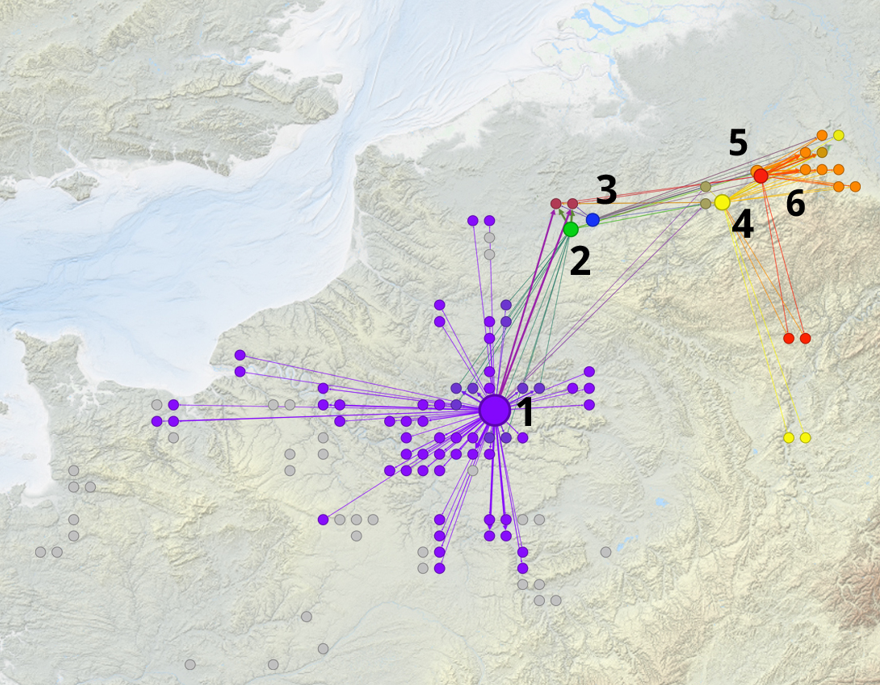
V tomto článku přehodnocujeme přechod od kultury s lineární keramikou (LBK) k různým post-LBK skupinám na severozápadním okraji střední Evropy, se zaměřením na sídelní klastry v Porýní (Německo), Limburgu (Nizozemsko) a Hesbaye (Belgie). Dosavadní výzkum byl roztříštěn moderními politickými hranicemi, které zastíraly kulturní a environmentální kontinuitu regionu v období neolitu. Tato studie přijímá nadregionální perspektivu a předkládá novou syntézu založenou na propojení harmonizovaných analýz materiální kultury a síťového modelování distribuce silicitových surovin. Naše výsledky naznačují období možné nestability, projevující se výrazným poklesem archeologicky doložených aktivit; kontinuita technických znalostí však zároveň poukazuje na hlubší strukturální stabilitu. Modelované sítě surovin ukazují strukturální proměnu v cirkulaci silicitových surovin mezi LBK a post-LBK obdobím. Domníváme se, že toto společné úsilí se stane základem pro ucelený, regionálně provázaný výklad tohoto zásadního přechodu v evropském neolitu.
Stažení
Reference
Allard, P. 2005: L’industrie lithique des populations rubanées du nord-est de la France et de la Belgique. Rahden/Westfalen: Verlag Marie Leidorf.
Allard, P. 2007: An economy of surplus production in the Early Neolithic of Hesbaye (Belgium): Bandkeramik blade debitage at Verlaine ‘Petit Paradis’. In: P. Allard – F. Bostyn – F. Giligny – J. Lech (eds.), Flint mining in the Prehistoric Europe, interpreting the archaeological records. BAR International series, 1891. Oxford: BAR Publishing, 31–40. DOI: https://doi.org/10.30861/9781407303710
Allard, P. – Delvigne, V. 2025: Lithic industries and stylistic entities during the Early Neolithic (LBK) in the Rhine-Meuse-Seine basins. Journal of Lithic Studies 12, 25 p. DOI: https://doi.org/10.2218/jls.9961
Amkreutz, L. 2016: It’s better to burn out than to fade away. A comparative perspective on the diversity in LBK endings in the Rhine–Meuse region. In: L. Amkreutz – F. Haack – D. Hofmann – I. van Wijk (eds.), Something out of the ordinary? Interpreting diversity in the Early Neolithic Linearbandkeramik and beyond. Newcastle upon Tyne: Cambridge Scholars Publishing, 357–400.
Asselin, G. – Le Brun-Ricalens, F. – Affolter, J. 2017: Entre bassin rhénan et Bassin parisien, le Néolithique moyen luxembourgeois et lorrain à travers son industrie en silex. In: M. Koch (ed.), Archäologie in der Großregion, Beiträge des internationalen Symposiums zur Archäologie in der Großregion in der Europäischen Akademie Otzenhausen. Nonnweiler: Europäische Akademie Otzenhausen, 139–162.
Balkowski, N. 2017: From Merzbachtal to the Graetheide? Mobility at the end of the Linear Pottery Culture. In: S. Scharl – B. Gehlen (eds.), Mobility in Prehistoric Sedentary Societies, Papers of the CRC 806 workshop (Cologne, 26–27 June 2015). Kölner Studien zur Prähistorischen Archäologie 8. Rahden/Westfalen: Verlag Marie Leidorf, 119–128.
Balkowski, N. 2024: Chronologie und Siedlungsstruktur des Fundplatzes. In: N. Balkowski – R. Peters (eds.), Der bandkeramische Fundplatz Arnoldsweiler-Ellebach. LVR-Amt für Bodendenkmalpflege im Rheinland. Rheinische Ausgrabungen, Band 85. Bonn: Dr. Rudolf Habelt, 43–133.
Balkowski, N. – Classen, E. – Peters, R. 2016: The older LBK site of Niederkassel-Uckendorf revisited. In: T. Kerig – K. Nowak – G. Roth (eds.), Alles was zählt: Festschrift für Andreas Zimmermann. Universitätsforschungen zur prähistorischen Archäologie, Band 285. Bonn: Dr. Rudolf Habelt, 79–92.
Barthelemy, M. 2014: Discussion: Social and spatial networks. Les Nouvelles de l’archéologie 135, 51–61. DOI: https://doi.org/10.4000/nda.2374
Blouet, V. 2005: L’industrie lithique du site Rubané moyen de Malling « le Domaine des Primevères » (Moselle). In: G. Auxiette – F. Malrain (eds.), Hommages à Claudine Pommepuy. Numéro spécial de la Revue Archéologique de Picardie NS 22. Amiens: Centre de Recherche Archéologique de la Vallée de l’Oise, 29–38. DOI: https://doi.org/10.3406/pica.2005.2719
Blouet, V. – Bosquet, D. – Constantin, C. – Fock, H. – Ilett, M. – Jadin, I. – Klag, T. – Petitdidier, M.-P. – Thomashausen, L. 2021: Le Rubané en Belgique : nouvelle chronologie céramique et synchronisation avec les régions voisines. Bulletin de la Société préhistorique française 118, 277–322. DOI: https://doi.org/10.3406/bspf.2021.15199
Blouet, V. – Klag, T. – Petitdidier, M.-P. – Thomashausen, L. – Ilett, M. – Constantin, C. 2013: Synchronisation des séquences du Rubané de Lorraine et du Bassin parisien. Bulletin de la Société préhistorique française 110, 513–537. DOI: https://doi.org/10.3406/bspf.2013.14294
Bosquet, D. – Fock, H. 2025: Rise and fall: Settlement dynamics of LBK groups in the Middle Belgium loess belt (5150–4950 cal. BC) based on the new Meuse ceramic chronology. Journal of Archaeological Science: Reports 61, 104940. DOI: https://doi.org/10.1016/j.jasrep.2024.104940
Bostyn, F. – Charraud, F. – Denis, S. 2019: Variabilités techniques, évolutions et aires d’influence des centres de productions laminaires au sein de la culture de Blicquy/Villeneuve-Saint-Germain. In: C. Montoya – J.-P. Fagnart – J.-L. Locht (eds.), Préhistoire de l’Europe du Nord-Ouest : mobilité, climats et identités culturelles. 28e Congrès préhistorique de France. Amiens: Société préhistorique française, 43–56.
Broich, M. 2016: Zwischen den Stühlen: Die Bandkeramik von Niederkassel-Mondorf. Cologne: Universität zu Köln. Unpublished Master Thesis.
Broich, M. 2021: Die Landwirtschaft im Mittelneolithikum – Demografie, Ökonomie, Umwelt. Cologne: Universität zu Köln. Unpublished PhD Thesis.
Brughmans, T. – Peeples, M. A. 2023: Network Science in Archaeology. Cambridge: Cambridge University Press. DOI: https://doi.org/10.1017/9781009170659
Burnez-Lanotte, L. – Caspar, J.-P. – Constantin, C. 1993: I Introduction. In: J.-P. Caspar – C. Constantin – A. Hauzeur – L. Burnez-Lanotte (eds.), Nouveaux éléments dans le groupe du Blicquy en Belgique : le site de Vaux-et-Borset ‘Gibour’ et ‘A la Croix Marie-Jeanne, III Le matériel lithique. Helinium 23, 67–79.
Caspar, J.-P. – Constantin, C. – Hauzeur, A. – Burnez, L. – Sidéra, I. – Docquier, J. – Louboutin, C. – Tromme, F. 1989: Groupe de Blicquy et Rubané à Vaux-et-Borset ‘Gibour’. Notae Praehistoricae 9, 49–59.
Charraud, F. 2022: La diffusion du silex du Cinglais au Néolithique ancien et moyen: Répartition, chronologie et modalités. Gallia Préhistoire 62, 73–123. DOI: https://doi.org/10.4000/galliap.2958
Constantin, C. 1985: Fin du Rubané, céramique du Limbourg et Post-Rubané. Le néolithique le plus ancien en Bassin Parisien et en Hainaut. BAR International serie 273. Oxford : BAR Publishing. DOI: https://doi.org/10.30861/9780860543466
Constantin, C. – Courtois, L. 1980: Utilisation d’os comme dégraissant dans certaines poteries néolithiques. In: E. A. Slater – J. O. Tate (eds.), Proceedings of the 16th International Symposium on Archeometry and Archaeological Prospection, Edinburgh, 1976. Edinburgh: National Museum of Antiquities of Scotland, 211–220.
Constantin, C. – Demarez, L. 1984: Cinq années de fouilles dans le Groupe de Blicquy (Belgique). Revue archéologique de Picardie 1984/1–2, 73–86. DOI: https://doi.org/10.3406/pica.1984.1400
Constantin, C. – Demoule, J.-P. 1982: Le groupe de Villeneuve-Saint-Germain. Helinium 22, 255–275.
Constantin, C. – Ilett, M. 1998: Culture de Blicquy-Villeneuve-Saint-Germain, rapports chronologiques avec les cultures rhénanes. Anthropologie et Préhistorie, 109, 207–216.
Claβen, E. – Schmidt, F. 2019: Kein Rauch ohne Feuer – Zur Deutung von Brandspuren in bandkeramischen Großbauten. In: J. Meurers-Balke – T. Zerl – R. Gerlach (eds.), Auf dem Holzweg… Eine Würdigung für Ursula Tegtmeier. Heidelberg: Propylaeum, 71–84.
Crabtree, S. A. – Borck, L. 2019: Social Networks for Archaeological Research. In: C. Smith (ed.), Encyclopedia of Global Archaeology. Cham: Springer International Publishing, 1–12. DOI: https://doi.org/10.1007/978-3-319-51726-1_2631-2
Denis, S. 2017: L’industrie lithique des populations blicquiennes (Néolithique ancien, Belgique): organisation des productions et réseaux de diffusion: petits échanges en famille. BAR international series 2873. Oxford: BAR Publishing. DOI: https://doi.org/10.30861/9781407316246
Denis, S. 2020: Intercultural contacts between BQY/VSG and GG/PF populations from the Aldenhoven Plateau and surrounding areas. In: V. Becker – J.-H. Bunnefeld – A. O’Neill – G. Woltermann – H.-J. Beier – R. Einicke (eds.), Go West! Kontakte zwischen Zentral- und Westeuropa. Varia Neolithica X. Langenweissbach: Beier & Beran, 39–44.
Denis, S. 2025: Man is a learner: transmission of technical know-how among knappers. The development of simple productions in post-Linear Pottery cultures in the German Rhineland. Archäologische Informationen 48, 153–168.
Denis, S. – Gjesfjeld, E. – Moreau, L. 2019: Post-Linear Pottery cultural boundary and repopulation of the German Rhineland: Revisiting the Western contacts hypothesis. Journal of Archaeological Science: Reports 23, 946–952. DOI: https://doi.org/10.1016/j.jasrep.2018.11.037
Denis, S. – Gomart, L. – Burnez-Lanotte, L. – Allard, P. 2024: Transmission of Lithic and Ceramic Technical Know-how in the Early Neolithic of Central-Western Europe: Shedding Light on the Social Mechanisms Underlying Cultural Transition. Journal of Neolithic Archaeology 26, 31–63. DOI: https://doi.org/10.12766/jna.2024.2
van Doosselaere, B. – Burnez-Lanotte, L. – Gomart, L. – Livingstone Smith, A. 2013: Analyse technologique de céramiques du Néolithique Ancien de Vaux-et-Borset (Belgique, Hesbaye): résultats préliminaires. Notae Praehistoricae 33, 15–26.
van Doosselaere, B. – Burnez-Lanotte, L. – Gomart, L. – Livingstone Smith, A. 2016: The End of Diversity ? Pottery Technology at the LBK Blicquy/Villeneuve-Saint-Germain Transition in Hesbaye, Belgium. In: L. Amkreutz – F. Haack – D. Hofmann – I. van Wijk (eds.), Something out of the ordinary? Interpreting diversity in the Early Neolithic Linearbandkeramik and beyond. Newcastle upon Tyne: Cambridge Scholars Publishing, 159–189.
Eisenhauer, U. 1999: Kulturwandel als Innovationsprozeß: Die fünf großen 'W' und die Verbreitung des Mittelneolithikums in Südwestdeutschland. Archäologische Informationen 22, 21–239.
Furholt, M. 2018: Translocal Communities – Exploring Mobility and Migration in Sedentary Societies of the European Neolithic and Early Bronze Age. Praehistorische Zeitschrift 92, 304–321. DOI: https://doi.org/10.1515/pz-2017-0024
Gehlen, B. – Schön, W. 2007: Céramique linéaire récente-début du Néolithique moyen-Rössen dans le Bassin à lignite rhénan. Les pièces lithiques comme reflets d’un monde changeant. In: F. Le Brun-Ricalens – F. Valotteau – A. Hauzeur (eds.), Relations interrégionales au Néolithique entre Bassin parisien et Bassin rhénan, 26è colloque interrégional sur le Néolithique, 8–9 nov. 2003. Archaeologia Mosellana 7. Luxembourg: Musée National d'Histoire et d'Art, 625–654.
Gehlen, B. – Schön, W. 2009a: Das frühe Mittelneolithikum: Steinartefaktinventare aus Langweiler 10, Hambach 260 und Langweiler 12. In: A. Zimmermann (ed.), Studien zum Alt- und Mittelneolithikum im Rheinischen Braunkohlerevier. Kölner Studien zur Prähistorischen Archäologie, 1. Rahden/Westfalen: Verlag Marie Leidorf, 237–286.
Gehlen, B. – Schön, W. 2009b: Jüngere Bandkeramik – Frühes Mittelneolithikum – Rössen im Rheinischen Braunkohlerevier: Steinartefakte als Spiegel einer sich verändernden Welt. In: A. Zimmermann (ed.), Studien zum Alt- und Mittelneolithikum im Rheinischen Braunkohlerevier. Kölner Studien zur Prähistorischen Archäologie, 1. Rahden/Westfalen: Verlag Marie Leidorf, 587–611.
van Gijn, A. L. – Verbaas, A. 2009: Reconstructing the life history of querns: the case of the LBK site in Geleen-Janskamperveld (NL). In: M. de Araujo Igreja – I. Conte (eds.), Recent Functional Studies on Non-flint Stone Tools: Methodological Improvements and Archaeological Inferences. Lisbon: CD-ROM Publication.
Gleser, R. – Hofmann, D. (eds.) 2019: Contacts, boundaries & innovation in the fifth millennium: exploring developed Neolithic societies in central Europe and beyond. Leiden: Sidestone Press.
Gomart, L. 2014: Traditions techniques & production céramique au Néolithique ancien: étude de huit sites rubanés du nord est de la France et de Belgique. Leiden: Sidestone Press.
Graefe, J. 2004: Altneolithische Mahlsteine im südlichen Niedersachsen. Jahrbuch des RGZM 51, 25–96.
de Grooth, M. 1987: The Organisation of Flint Tool Manufacture in the Dutch Bandkeramik. Analecta Praehistorica Leidensia 20, 27–52.
de Grooth, M. 2015: The ‘Rijckholt’ Connection: Neolithic extraction and circulation of Lanaye flints. In: T. Kerig – S. Shennan (eds.), Connecting networks: characterising contacts by measuring lithic exchange in the European Neolithic. Oxford: Archaeopress Archaeology, 24–41. DOI: https://doi.org/10.2307/j.ctv1pzk1hm.8
Haesaerts, P. – Pirson, S. – Meijs, E. 2011: New proposal for the Quaternary lithostratigraphic units (Belgium). Aeolian sediments. National Commission for Stratigraphy, Subcommission Quaternary, 1–7.
Hamon, C. 2006: Broyage et abrasion au Néolithique ancien: caractérisation technique et fonctionnelle des outillages en grès du Bassin parisien. BAR international series 1551. Oxford: BAR Publishing. DOI: https://doi.org/10.30861/9781841719801
Hamon, C. 2008: Meules rubanées, meules blicquiennes : nouvelles réflexions sur les dépôts du Hainaut (Belgique). In: L. Burnez-Lanotte – M. Ilett – P. Allard (eds.), Fin des traditions danubiennes dans le Néolithique du Bassin parisien (5100–4700 av. J.-C). Autour des recherches de Claude Constantin. Paris – Namur: Société préhistorique française – Presses Universitaires de Namur, 197–208.
Hamon, C. 2020: Isn’t it strange? Grinding tool deposits and deposition in the north-western LBK. In: D. Hofmann (ed.), Magical, Mundane or Marginal? Deposition practices in the Early Neolithic Linearbandkeramik culture. Leiden: Sidestone Press, 33–52.
Hamon, C. 2022: Grinding systems as cultural markers at the turn of the 6th millennium BC in north-western continental Europe. In: S. Valamoti – A. Dimoula – M. Ntinou (eds.), Cooking with plants in ancient Europe and beyond. Interdisciplinary approaches to the archaeology of plant foods. Leiden: Sidestone Press, 335–347.
Hauzeur, A. – Jadin, I. 2025: Le Néolithique ancien oriental : deux territoires pour une même culture ou deux cultures pour un même territoire ? In: M. Otte (ed.), Les territoires culturels entre Seine et Rhin. De la Préhistoire à l’an 1000. Flémalle : Préhistomuseum, 274–299.
Heinen, M. 2005: Niederkassel-Uckendorf – Neue Erkenntnisse zum Beginn des Neolithikums in Nordrhein-Westfalen. Schriften zur Bodendenkmalpflege in Nordrhein-Westfalen 8. In: H. G. Horn (ed.), Von Anfang an: Archäologie in Nordrhein-Westfalen. Mainz am Rhein: von Zabern, 333–335.
Heinen, M. 2011: Erste Gräber Der Grossgartacher Kultur Im Rheinland. Archäologie Im Rheinland 2010, 71–73.
Heinen, M. 2015: Die bandkeramische Pioniersiedlung von Niederkassel-Uckendorf. In: T. Otten – J. Kunow – M. M. Rind – M. Trier (eds.), REVOLUTION jungSTEINZEIT. Stuttgart: Theiss-Verlag (Schriften zur Bodendenkmalpflege in Nordrhein-Westfalen, 11), 325–329.
Heinen, M. – Nehren, R. – Weiner, J. 2004: Älteste Bandkeramik und Flomborn. Der Fundplatz Uckendorf wirft neue Fragen auf. Archäologie Im Rheinland 2003–2004, 27–29.
Jadin, I. 2003: Trois petits tours et puis s’en vont...La fin de la présence danubienne en Moyenne Belgique. ERAUL 109. Liège : Université de Liège.
Kempf, M. – Denis, S. 2024: Resource dependency and communication networks in Early Neolithic western Europe. Quaternary Environments and Humans, 100014. DOI: https://doi.org/10.1016/j.qeh.2024.100014
Kerig, T. 2008: Hanau-Mittelbuchen Siedlung und Erdwerk der bandkeramischen Kultur ; Materialvorlage, Chronologie, Versuch einer handlungstheoretischen Interpretation. Universitätsforschungen zur prähistorischen Archäologie 156. Bonn: Dr. Rudolf Habelt.
Kerig, T. – Hilpert, J. in press: Directed Percolation – A visual interpretation of exchange networks and social inequality in the Western LBK. In: T. Kerig – J. Hilpert (eds.), Big Exchange: Inequalities in supra-regional Exchange Networks. Leiden: Sidestone Press.
Kerig, T. – Hilpert, J. – Strohm, S. – Berger, D. – Denis, S. et al. 2023: Interlinking research: the ‘Big Exchange’ project. Antiquity 97, e22. DOI: https://doi.org/10.15184/aqy.2023.78
Kerig, T. – Shennan, S. 2015: Connecting networks: characterising contacts by measuring lithic exchange in the European Neolithic. Oxford: Archaeopress Archaeology. DOI: https://doi.org/10.2307/j.ctv1pzk1hm
Kroon, E. 2024: Serial Learners. Interactions between Funnel Beaker West and Corded Ware Communities in the Netherlands during the Third Millennium BCE from the Perspective of Ceramic Technology. Leiden: Sidestone Press Dissertations. DOI: https://doi.org/10.59641/4e367hq
Kroon, E. – Allard, P. – Amkreutz, L. – Bosquet, D. – Deramaix, I. et al. in press: Settlement and temporal dynamics during the LBK and post-LBK transition: A study of the loessic corridor from the Rhineland to Hesbaye (Germany, the Netherlands, Belgium). Archeologické rozhledy.
Lanting, J. N. – van der Plicht, J. 2002: De 14C-chronologie van de Nederlandse pre- en protohistorie III: Neolithicum. Palaeohistoria 1999/2000, 41/42, 1–110.
van der Leije, J. – van der Linde, C. M. – Knippenberg, S. – Blom, E. in preparation: Opgravingen te Angeren-Kampsepad en Angeren-Kraaijenstraat, Archol-rapport.
Louwe Kooijmans, L. 2005: Hunters become farmers: Early Neolithic B and Middle Neolithic A. In: L. Louwe Kooijmans – P. van den Broeke – H. Fokkens – A. Gijn (eds.), The Prehistory of the Netherlands. Amsterdam: University Press, 249–272. DOI: https://doi.org/10.5117/9789053561607
Louwe Kooijmans, L. P. 2022: Successive adoptions. The origins of the Neolithic in the Low Countries. In: M. Grygiel – P. Obst (eds.), Walking among ancient trees: Studies in honour of Ryszard Grygiel and Peter Bogucki on the 45th anniversary of their research collaboration. Łódź: Wydawnictwo Fundacji Badań Archeologicznych Imienia Profesora Konrada Jażdżewskiego, 363–367.
Lüning, J. 2005: Bandkeramische Hofplätze und die absolute Chronologie der Bandkeramik. In: J. Lüning – C. Frirdich – A. Zimmermann (eds.), Die Bandkeramik im 21. Jahrhundert Symposium in der Abtei Brauweiler bei Köln vom 16.9.–19.9.2002. Rahden/Westfalen: Verlag Marie Leidorf, 49–74.
Mateiciucová, I. – Trnka, G. 2015: Long-Distance Distribution of Raw Materials for Chipped Stone Artefacts in the Neolithic of Central Europe (Moravia and Eastern Austria) in the 6th and 5th Millennia BC. In: T. Kerig – S. Shennan (eds.), Connecting networks: characterising contacts by measuring lithic exchange in the European Neolithic. Oxford: Archaeopress Archaeology, 8–15. DOI: https://doi.org/10.2307/j.ctv1pzk1hm.6
Meier-Arendt, W. 1975: Die Hinkelstein-Gruppe, der Übergang vom Früh- zum Mittelneolithikum in Südwestdeutschland. Römisch-Germanische Forschungen, 35. Berlin: de Gruyter.
Meijs, E. P. M. 2002: Loess stratigraphy in Dutch and Belgian Limburg. E&G Quaternary Science Journal 51, 115–131. DOI: https://doi.org/10.3285/eg.51.1.08
Modderman, P. J. R. 1970: Linearbandkeramik aus Elsloo und Stein. Analecta Praehistorica Leidensia 3. Leiden: Sidestone press. DOI: https://doi.org/10.1163/9789004663671
Molthof, H. M. – Baetsen, S. 2022: Two new Swifterbant settlements at Nieuwegein-Het Klooster, the Netherlands: preliminary site interpretation and overview of human remains. In: F. Klimscha – M. Heumüller – D. C. M. Raemaekers – H. Peeters – T. Terberger (eds.), Stone age borderland experience: Neolithic and Late Mesolithic parallel societies in the North European plain. Materialhefte zur Ur- und Frühgeschichte Niedersachsens 60. Rahden/Westfalen: Verlag Marie Leidorf, 85–97.
Morell-Rovira, B. – Bickle, P. – Hamilton, D. – Díaz-Zorita Bonilla, M. – Francken, M. – Masclans, A. 2025: New temporal dimensions of the Linearbandkeramik cemetery horizon in Schwetzingen (Germany). Antiquity 99, 1212–1229. DOI: https://doi.org/10.15184/aqy.2025.10169
Nowak, K. 2013: Mittelneolithische Silexaustauschsysteme Auf Der Aldenhovener Platte Und in Ihrer Umgebung. Cologne: Universität zu Köln. Unpublished PhD thesis.
Nowak, K. 2014: Flint Exchange during Middle Neolithic Times – a Case Study from Western Germany. In: F. Bostyn – F. Giligny (eds.), Lithic Raw Material Resources and Procurement in Pre- and Protohistoric Times. BAR international series 2656. Oxford: BAR Publishing, 107–120.
Olalde, I. – Altena, E. – Bourgeois, Q. – Fokkens, H. – Amkreutz, L. et al. 2025: Long-term hunter-gatherer continuity in the Rhine-Meuse region was disrupted by local formation of expansive Bell Beaker groups. bioRxiv, 27 p. DOI: https://doi.org/10.1101/2025.03.24.644985
Östborn, P. – Gerding, H. 2014: Network analysis of archaeological data: a systematic approach. Journal of Archaeological Science 46, 75–88. DOI: https://doi.org/10.1016/j.jas.2014.03.015
Perlès, C. 2012: Quand ‘diffusion’ ne veut pas dire ‘interaction’. In: M. Borrell – F. Borrell – J. Bosch – X. Clop – M. Molist (eds.), Rubricatum, revista del Museu de Gavà 5. Actes del Congrés Internacional Xarxes al Neolític – Neolithic Networks. Gavà: Institut Municipal de Gestió del Patrimoni Cultural i Natural Ajuntament de Gavà., 585–589.
Peters, R. 2024: Gräberfeld. In: N. Balkowski – R. Peters (eds.), Der bandkeramische Fundplatz Arnoldsweiler-Ellebach. Rheinische Ausgrabungen 85. Bonn: Dr. Rudolf Habelt, 311–339.
Peters, R. – Zimmermann, A. 2017: Resilience and Cyclicity: Towards a macrohistory of the Central European Neolithic. Quaternary International 446, 43–53. DOI: https://doi.org/10.1016/j.quaint.2017.03.073
Roth, G. 2008: Geben und Nehmen. Eine wirtschaftshistorische Studie zum neolithischen Hornsteinbergbau von Abensberg-Arnhofen, Kr. Kelheim (Niederbayern). Cologne: Universität zu Köln. Unpublished PhD thesis.
Roux, V. – Bril, B. – Cauliez, J. – Goujon, A.-L. – Lara, C. – Manen, C. – de Saulieu, G. – Zangato, E. 2017: Persisting technological boundaries: Social interactions, cognitive correlations and polarization. Journal of Anthropological Archaeology 48, 320–335. DOI: https://doi.org/10.1016/j.jaa.2017.09.004
Scharl, S. 2015: Lithic exchange systems during the LBK-Post-LBK transition: dramatic change or continuous development? A case study from Northwestern Bavaria. Anthropologie 53, 375–386.
Scharl, S. – Denis, S. – Collin, J.-P. – Allard, P. – Delvigne, V. – Gehlen, B. – Grooth, M. E. Th. de – Koch, I. – Schyle, D. 2021: Studying Neolithic lithics – from a cross-border dialogue to a common language. Journal of Neolithic Archaeology 23, 115–128. DOI: https://doi.org/10.12766/jna.2021.5
Scharl, S. – Gehlen, B. – Friedrich, R. – Knipper, C. – Meyer, C. – Suhrbier, S. 2023: Die neolithischen Bestattungen von Müddersheim: Datierung, Mobilität, Ernährung. Bonner Jahrbücher 222. Darmstadt: von Zabern, 7–41.
Scharl, S. – Suhrbier, S. – Zerl, T. 2025: Settlement patterns, mobility and agricultural practice in the Rhineland during the second half of the 5th millennium BCE –an overview of the current state of research. In: R. Gleser – S. Scharl – U. Seidel – M. Strobel (eds.), Neue Funde im Osten – Entstehung, Verbreitung und Charakteristik des Phänomens Michelsberg im Lichte neuer Forschungen – New finds in the East – origins, spread and characteristics of the Michelsberg phenomenon in the light of new research. Beiträge zur Internationalen Konferenz in Münster 2023. Neolithikum und ältere Metallzeiten 5. Münster: LIT Verlag, 401–422.
Schirmer, W. 2016: Late Pleistocene loess of the Lower Rhine. Quaternary International 411, 44–61. DOI: https://doi.org/10.1016/j.quaint.2016.01.034
Schmidgen-Hager, E. 1993: Bandkeramik im Moseltal. Universitätsforschungen zur prähistorischen Archäologie 18. Bonn: Dr. Rudolf Habelt.
Shennan, S. 2018: The Spread of Farming into Central Europe. In: S. Shennan (ed.), The First Farmers of Europe: An Evolutionary Perspective. Cambridge: Cambridge University Press, 79–105. DOI: https://doi.org/10.1017/9781108386029.005
Spatz, H. 1991: Der ‘Langweiler Typus’. Ein Nachweis der Gruppe Blicquy im Rheinland. Germania 69, 155–162.
Spatz, H. 1996: Beiträge zum Kulturenkomplex Hinkelstein-Grossgartach-Rössen: Der keramische Fundstoff des Mittelneolithikums aus dem mittleren Neckarland und seine zeitliche Gliederung. Materialhefte zur Archaologie in Baden-Württemberg 37. Stuttgart: Theiss.
Suhrbier, S. – Scharl, S. 2023: Combining geometric morphometrics and redundancy analysis to analyse Neolithic architecture – A case study on southwest German longhouses 5000–4500 BCE. Journal of Archaeological Science 154, 105771. DOI: https://doi.org/10.1016/j.jas.2023.105771
Teetaert, D. 2020: Routes of technology. Pottery production and mobility during the Mesolithic-Neolithic transition in the Scheldt river valley (Belgium). Ghent: Ghent University. Unpublished PhD Thesis.
Ten Anscher, T. J. 2023: Synthese: Medel in de Swifterbant-periode. In: T. J. Ten Anscher – S. Knippenberg – C. M. van der Linde – W. Roessingh – N. W. Willemse (eds.), Doorbraken aan de Rijn. Een Swifterbant-gehucht, een Hazendonk-nederzetting en erven en graven uit de bronstijd in Medel-De Roeskamp, Weesp – Leiden – Amersfoort – ’s-Hertogenbosch: RAAP– Archol – ADC ArcheoProjectenRapport – BAAC, 827–888.
Thisse-Derouette, R. – Thisse-Derouette, J. – Thisse, J. junior 1952: Découverte d’un cimetière omalien, à rite funéraire en deux temps (crémation et enfouissement de cendres), en Hesbaye liégeoise à Hollogne-aux-Pierres. Bulletin de la Société préhistorique de France 49, 175–190. DOI: https://doi.org/10.3406/bspf.1952.8042
Trampota, F. – Květina, P. 2020: How do they fit together? A case study of Neolithic pottery typology and radiocarbon chronology. Archeologické rozhledy 72, 163–193. DOI: https://doi.org/10.35686/AR.2020.6
van de Velde, P. 1979: On Bandkeramik social structure: an analysis of pot decoration and hut distributions from the central European neolithic communities of Elsloo and Hienheim. Analecta Praehistorica Leidensia, 12. Leiden: Brill. DOI: https://doi.org/10.1163/9789004673694
van de Velde, P. – van Wijk, I. 2014: De huizen van de Bandkeramiek (LBK) in Nederland. In: A.G. Lange – E.M. Theunissen – J.H.C. Deeben – J. van Doesburg – J. Bouwmeester – T. de Groot (eds.), Huisplattegronden in Nederland. Archeologische sporen van het huis. Amersfoort: Barkhuis.
Verbaas, A. 2014: Steen. In: I. van Wijk – L. Amkreutz – P. van de Velde (eds.), « Vergeten » Bandkeramieke Een Odyssee naar de oudste neolithische bewoning in Nederland. Leiden: Sidestone press, 517–526.
Verbaas, A. – van Gijn, A. L. 2007: Use wear analysis of the flint tools from Geleen-Janskamperveld. In: P. van de Velde (ed.), Excavations at Geleen-Janskamperveld 1990/1991. Analecta Praehistorica Leidensia 39. Leiden: Sidestone press, 173–184.
Verhart, L. 2012: Contact in stone: Adzes, Keile and Spitzhauen in the Lower Rhine Basin. Journal of Archaeology in the Low Countries 4, 5–35.
Wasserman, S. – Faust, K. 1994: Social Network Analysis: Methods and Applications. Structural Analysis in the Social Sciences 8. Cambridge: Cambridge University Press. DOI: https://doi.org/10.1017/CBO9780511815478
van Wijk, I. (ed.) 2016: Settlement dynamics on the Cannerberg. Archaeological Research of Bandkeramik and Iron Age settlements. Leiden: Sidestone Press.
van Wijk, I. in preparation: Footsteps of the First Farmers. Leiden: Leiden University. PhD Thesis.
van Wijk, I. – Amkreutz, L. W. S. W. (eds.) 2022: Elsloo-Koolweg revisited: science-based perspectives on the burials and grave goods of the Linear Bandkeramik burial ground of Elsloo-Koolweg. Nederlandse archeologische rapporten, 76. Amersfoort: Cultural Heritage Agency of the Netherlands.
Zimmermann, A. 1988: Steinmaterial. In: U. Boelicke – D. von Brandt – J. Lüning – P. Stehli – A. Zimmermann (eds.), Der Bandkeramische Siedlungsplatz Langweiler 8, Gem. Aldenhoven, Kr. Düren. Beiträge zur neolithischen Besiedlung der Aldenhovener Platte III. Rheinische Ausgrabungen, 28. Köln: Rheinland Verl., 560–787.
Zimmermann, A. 1995: Austauschsysteme von Silexartefakten in der Bandkeramik Mitteleuropas: von Andreas Zimmermann. Universitätsforschungen zur prähistorischen Archäologie 26. Bonn: Dr. Rudolf Habelt.
Zimmermann, A. 2002: Landschaftsarchäologie I. Die Bandkeramik auf der Aldenhovener Platte. Bericht der Römisch-Germanischen Kommission 83, 17–38.
Zimmermann, A. 2012: Das Hofplatzmodell – Entwicklung, Probleme, Perspektiven. In: R. Smolik (ed.), Siedlungsstruktur und Kulturwandel in der Bandkeramik: Beiträge der Internationalen Tagung ‘Neue Fragen zur Bandkeramik oder alles beim Alten?!,’Leipzig, 23. bis 24. September 2010. Arbeits- und Forschungsberichte zur sächsischen Bodendenkmalpflege 25. Dresden: Landesamt für Archäologie – Freistaat Sachsen, 11–20.
Zimmermann, A. – Meurers-Balke, J. – Kalis, A. J. 2007: Das Neolithikum im Rheinland. Bonner Jahrbücher 205, 1–63.
Zimmermann, A. – Scharl, S. – Schmidt, I. 2020: Demographic Transitions – Cycles and Mobility in the Neolithic of Western Germany. In: T. Lachenal – R. Roure – O. Lemercier (eds.), Demography and Migration Population trajectories from the Neolithic to the Iron Age. Proceedings of the XVIII UISPP World Congress (4–9 June 2018, Paris, France) Volume 5: Sessions XXXII-2 and XXXIV-8. Oxford: Archaeopress, 86–97. DOI: https://doi.org/10.2307/jj.15135925.10
Stahování
Publikováno
Jak citovat
Licence
Copyright (c) 2026 Solène Denis, Pierre Allard, Luc Amkreutz, Dominique Bosquet, Isabelle Deramaix, Heike Fock, Louise Gomart, Caroline Hamon, Johanna Hilpert, Ivan Jadin, Erik J. Kroon, Robin Peters, Silviane Scharl, Ivo van Wijk

Tato práce je licencována pod Mezinárodní licencí Creative Commons Attribution 4.0 .