
An early medieval sword with a Carolingian K-type pommel from Varín in Northwestern Slovakia
A status symbol rather than a weapon
DOI:
https://doi.org/10.35686/AR.2026.317Keywords:
Early Middle Ages, Carolingian period, Carolingian sword, elites, metallographyAbstract
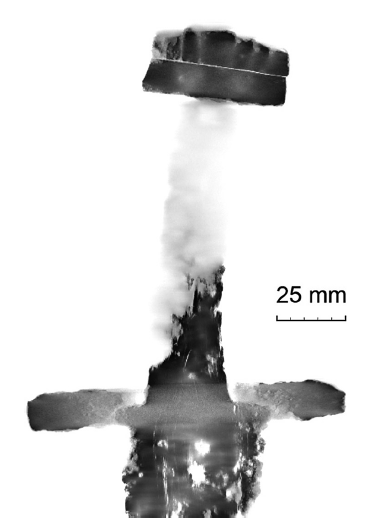
Early medieval swords, Carolingian or Viking, are treated and usually discussed in the literature as finds related to elites. In real life, however, second-grade swords were also made, and old and used weapons were repaired and traded. Lower-quality items were used by people with aspirations who could not afford to acquire expensive signs of status. Here, the author describes the find of a Carolingian-type sword from Varín in Northwestern Slovakia, which is determined to be a difficult-to-classify, low-end, early medieval product. However, it fits into the historical context of Carolingian times, when a class of new European nobility was forming. These considerations shed new light on the genesis of this social group.
Downloads
References
Althoff, G. 2013: Die Macht der Rituale, Symbolik und Herrschaft im Mittelalter. Darmstadt: WBG.
Androshchuk, F. 2014: Viking Swords: Swords and social aspects of weaponry in Viking Age societies. Stockholm: The National Historical Museum.
Bálint, C. 2019: The Avars, Byzantium and Italy. A Study in Chorology and Cultural History. Budapest: Archaeolingua.
Bilogrivić, G. 2009: Type K Carolingian Swords. Opuscula archaeologica 33, 125–182.
Bilogrivić, G. 2013: Carolingian Swords from Croatia – New Thoughts on an Old Topic. Studia Universitatis Cibiniensis. Series Historica 10, 67–83.
Bilogrivić, G. 2018: Carolingian Weapons and the Problem of Croat Migration and Ethnogenesis. In: D. Dzino – A. Milošević – T. Vedriš (eds.), Migration, Integration and Connectivity on the Southeastern Frontier of the Carolingian Empire. Leiden – Boston: Brill, 86–99.
Bilogrivić, G. 2019: Formation of the Identity of the Elite in Eastern Adriatic Hinterland in the Late 8th Century and Early 9th – the Role of Carolingian Weaponry. VAMZ Series 3 52, 113–147.
Bougard, F. – Bührer-Thierry, G. – Le Jan, R. 2013: Elites in the Early Middle Ages, Identities, Strategies, Mobility. Annales (English ed) 68, 733–768.
Brunning, S. 2019: The Sword in Early Medieval Northern Europe. Experience, Identity, Representation. Woodbridge: Boydell & Brewer.
Budinský-Krička, V. 1959: Slovanské mohyly v Skalici. Bratislava: Slovak Academy of Sciences.
Classen, A. 2020: Symbolic Significance of the Sword in the Hero’s Hand: Beowulf, The Nibelungenlied, El Poema de Mio Cid, Volsunga Saga, and Njál’s Saga. Thing Theory from a Medieval Perspective. Amsterdamer Beiträge zur älteren Germanistik 80, 346–370.
Cook, A. C. – Southon, J. R. – Wadsworth, J. N. M. I. 2003: Using radiocarbon dating to establish the age of iron-based artifacts. The Journal of The Minerals, Metals & Materials Society 55(5), 15–22.
Csiky, G. 2015: Avar-Age Polearms and Edged Weapons. Classification, Typology, Chronology and Technology. Leiden-Boston: Brill.
Ellis-Davidson, H. R. 1962: The Sword in Anglo-Saxon England. Its Archaeology and Literature. Re-edition 1998. Woodbridge: Boydell & Brewer.
Fedrigo, A. – Grazzi, F. – Williams, A. R. – Panzner, T. – Lefmann, K. – Lindelof, P. L. – Jørgensen, L. – Pentz, P. – Scherillo, A. – Porcher, F. – Strobl, M. 2017: Extraction of archaeological information from metallic artefacts. A neutron diffraction study on Viking swords. Journal of Archaeological Science: Reports 12, 425–436.
Foote, P. G. – Wilson, D. M. 1970: The Viking achievement, the society and culture of early medieval Scandinavia. Reprint 1984. London: Sidgwick and Jackson.
Garipzanov, I. 2008: The Symbolic Language of Authority in the Carolingian World (c. 751–877). Leiden – Boston: Brill.
Geibig, A. 1991: Beiträge zur morphologischen Entwicklung des Schwertes im Mittelalter. Eine Analyse des Fundmaterials vom ausgehenden 8. bis zum 12. Jahrhundert aus Sammlungen der Bundesrepublik Deutschland. Neumünster: Wachholtz.
Geibig, A. 1999: Die Schwerter aus dem Hafen von Haithabu. Berichte über die Ausgrabungen in Haithabu 33, 9–99.
Grygiel, M. 2023: Early Medieval Finds from Czechowice (Gliwice/PL). Archäologisches Korrespondenzblatt 53, 113–136.
Hanuliak, M. 2001: K problematike včasnostredovekého mohylového rítu na území Slovenska. Slovenská archeológia 49, 277–299.
Haramza, M. 2019: A 9–10. századi Kárpát-medencei szablyák archeometallurgiai és hadtörténeti vonatkozása. Budapest: Pázmány Péter Catholic University. Unpublished PhD thesis.
Härke, H. 2000: The Circulation of Weapons in Anglo-Saxon Society. In: F. Theuws – J. L. Nelson (eds.), Rituals of Power. From Late Antiquity to the Early Middle Ages. Leiden – Boston: Brill, 377–399.
Hošek, J. – Haramza, M. 2018: Metallographic examination of four 7th–8th century long-blade weapons from Želovce (Slovakia). Archeologické rozhledy 70, 468–482.
Hošek, J. – Košta, J. – Žákovský, P. 2019: Ninth to mid-sixteenth Century Swords from the Czech Republic in their European Context. Part I. The Finds. Prague – Brno: Czech Academy of Sciences.
Hošek, J. – Košta, J. – Žákovský, P. 2021: Ninth to mid-sixteenth Century Swords from the Czech Republic in their European Context. Part II. Sword of medieval and early Renaissance Europe as a technological and archaeological sources. Prague – Brno: Czech Academy of Sciences.
Jakobsson, M. 1992: Krigarideologi och vikingatida svärdstypologi. Stockholm: Stockholm University.
Jelovina, D. 1986: Mačevi i ostruge karolinškog obilježja u Muzeju Hrvatskih Arheoloških Spomenika. Schwerter und Sporen karolingischer Formgebung in Museum Kroatischer Archäologischer Denkmäler. Split: MHAS.
Jocsik, K. – Môc, R. 2024: Petersen’s Type X Sword from Malé Kozmálovce, Slovakia. Project Forlǫg, Reenactment and science [online]. [accessed 21 October 2024] https://doi.org/10.59500/HQRK8961
Košta, J. 2005: Přehled vývoje mečů karolinského typu. Stredočeský vlastivědný sborník 23, 159–172.
Košta, J. 2014: Vývoj bádání nad tříděním mečů z 2. poloviny 8. až přelomu 10. a 11. století. Praehistorica 32(2), 233–252.
Košta, J. 2020: Ninth- and Tenth-Century Swords in Moravia. Weapons, Top Smithery Products and Symbols of Power. In: L. Poláček et al., Great Moravian Elites from Mikulčice. Brno: Czech Academy of Sciences, 231–244.
Košta, J. – Hošek, J. 2014: Early Medieval Swords from Mikulčice. Studien zum Burgwall von Mikulčice X. Brno: Czech Academy of Sciences.
Košta, J. – Hošek, J. 2019: Schwerter und Schwertfragmente aus dem großmährischen Zentrum in Mikulčice. In: L. Poláček – P. Kouřil (eds.), Bewaffnung und Reiterausrüstung des 8. bis 10. Jahrhunderts in Mitteleuropa. Brno: Czech Academy of Sciences, 151–180.
Le Jan, R. 2000a: Continuity and Change in the Tenth-Century Nobility. In: A. J. Duggan (ed.), Nobles and Nobility in Medieval Europe. Concepts, Origins, Transformations. Woodbridge: Boydell & Brewer, 53–68.
Le Jan, R. 2000b: Frankish giving of arms and rituals of power, continuity and change in the Carolingian period. In: F. Theuws – J. L. Nelson (eds.), Rituals of Power. From Late Antiquity to the Early Middle Ages. Leiden – Boston: Brill, 281–309.
Loveluck, C. 2011: Problems of the definition and conceptualisation of early medieval elites, AD 450–900, the dynamics of the archaeological evidence. In: F. Bougard (ed.), Théorie et pratiques des élites au Haut Moyen Âge. Conception, perception et réalisation sociale. Theorie und Praxis frühmittelalterlicher Eliten. Konzepte, Wahrnehmung und soziale Umsetzung. Turnhout: Brepols, 21–68.
Macháček, J. – Berner, M. – Dresler, P. – Kaupová Drtikolová, S. – Přichystalová, R. – Sládek, V. 2021: Arms-bearers in separate graves from Great Moravia and the emergence of the Early Medieval military-aristocratic organization in East-Central Europe. Prähistorische Zeitschrift 96, 248–285.
Marek, L. 2005: Early Medieval Swords from Central and Eastern Europe: Dilemmas of an Archaeologist and a Student of Arms. Wrocław: Wydawnictwo Uniwersytetu Wrocławskiego.
Martens, I. 2004: Indigenous and imported Viking Age weapons in Norway – a problem with European implications. Journal of Nordic Archaeological Science 14, 125–137.
Martens, I. – Astrup, E. E. 2021: Viking Age Swords from Telemark, Norway. An Integrated Technical and Archaeological Investigation. Oslo: Capellen Damm Akademisk.
Mäder, S. 2019: Challenging Typologies: Swords in the Utrecht Psalter. In: L. Deutscher – M. Kaiser – S. Wetzler (eds.), The Sword. Form and Tought. Woodbridge: Boydell & Brewer, 12–23.
Menghin, W. 1980: Neue Inschriftenschwerter aus Süddeutschland und die Chronologie karolingischen Spathen auf dem Kontinent. In: Spindler K. (ed.), Vorzeit zwischen Main und Donau. Neue archäologische Forschungen und Funde aus Franken und Altbayern. Erlangen: Universitätsbund Erlangen-Nürnberg, 227–272.
Milošević, A. 2012: Novi mač iz Koljana u svjetlu kontakata s nordijskim zemljama u ranom srednjem vijeku. Histria antiqua 21, 459–470.
Milošević, A. 2016: Doseljenje Hrvata u Dalmaciju krajem 8. stoljeća: mač K-tipa iz Koljana kao mogući dokaz. Starohrvatska prosvjeta III/43, 239–262.
Moilanen, M. 2015: Marks of Fire, Value and Faith. Swords with Ferrous Inlays in Finland during the Late Iron Age. ca. 700–1200 AD. Turku: The Society for Medieval Archaeology in Finland.
Moravčík, J. 2000: Najstaršie osídlenie obcí v okoli vodného diela Žilina od staršej doby kamennej po stredovek. Vlastivedný zborník Považia 20, 123–153.
Müller-Wille, M. 1976: Das Bootkammergrab von Haithabu. Neumünster: Wachholtz.
Müller-Wille, M. 1982: Zwei karolingische Schwerter aus Mittelnorwegen. In: H.-J. Häßler et al. (eds.), Studien zur Sachsenforschung 3, Veröffentlichungen der urgeschichtlichen Sammlungen des Landesmuseums zu Hannover 27. Hildesheim: Lax, 101–154.
Nelson, J. L. 1986: Politics and Ritual in Early Medieval Europe. London-Ronceverte: The Hambledon Press.
Nelson, J. L. 2008: Kingship and royal government. In: R. McKitterick (ed.), The New Cambridge Medieval History II c. 700–c. 900. Cambridge: Cambridge University Press, 381–430.
Oakeshott, R. E. 2001: Sword in Hand. A History of the Medieval Sword. Minneapolis: Arms & Armor Inc.
Paulsen, P. 1956: Einige Säbelschwerter des 5. bis 7. Jahrhunderts n. Chr. Archaeologia Geographica 6, 1–40.
Pearce, M. 2012: The Spirit of the Sword and Spear. Cambridge Archaeological Journal 23, 55–67.
Peirce, I. 2002: Swords of the Viking Age. Woodbridge: Boydell Press.
Petersen, J. 1919: De Norske Vikingesverd. En Typologisk-Kronologisk Studie Over Vikingetidens Vaaben. Kristiania: Jacob Dybwad.
Petri, I. 2019: Material and Properties of VLFBERHT Swords. In: L. Deutscher – M. Kaiser – S. Wetzler (eds.), The Sword. Form and Tought. Woodbridge: Boydell & Brewer, 61–88.
Pinter, Z.-K. 2007: Spada şi sabia medievală în Transilvania şi Banat (secolele IX–XIV). Sibiu: Banatica.
Piteša, A. 2001: Karolinški mač s natpisom iz Zadvarja (Žeževica Donja). Vjesnik za arheologiju i historiju dalmatinsku 94, 347–60.
Pleiner, R. 1967: Die Technologie des Schmiedes in der Großmährischen Kultur. Slovenská archeológia 15(1), 77–188.
Pleiner, R. 1990: Die Technologie eines frühmittelalterlichen Schwertes aus Varín, Slowakei. Archeologické rozhledy 42, 674–679, 732–734.
Pohl, W. 2018: The Avars. A Steppe Empire in Central Europe 567–822. Ithaca – London: Cornell University Press.
Poláček, L. et al. 2020: Great Moravian Elites from Mikulčice. Brno: Czech Academy of Sciences.
Radišić, M. – Bilogrivić, G. 2024: Pommelless swords with rhomboid crossguards in the early middle ages. A research contribution from the southern Carpathian basin. Starinar 74, 265–282.
Robak, Z. 2013: Studia nad okuciami rzemieni w typie karolińskim. VIII–X wiek. Część I. Nitra: Slovak Academy of Sciences.
Robak, Z. 2014: Studia nad okuciami rzemieni w typie karolińskim. VIII–X wiek. Część II. Nitra: Slovak Academy of Sciences.
Robak, Z. 2017: The origins and the collapse of the Blatnica-Mikulčice Paradigm. Slovenská archeológia 65, 99–162.
Robak, Z. 2017–2018: Chronology and periodisation of imports of Carolingian military equipment in the Carpathian Basin between the 8th and the 10th centuries. Antaeus 35–36, 327–344.
Robak, Z. 2018: The Sword and Sword-belt in Carolingian Times. The Warrior Burial 23 from Závada Reconsidered. Študijné zvesti Archeologického ústavu SAV 64, 149–177.
Ruttkay, A. 1975: Waffen und Reiterausrüstung des 9. bis zur ersten Hälfte des 14. Jahrhunderts in der Slowakei (I). Slovenská archeológia 23, 119–216.
Sayer, D. – Sebo, E. – Hughes, K. 2019: A Double-edged Sword. Swords, Bodies, and Personhood in Early Medieval Archaeology and Literature. European Journal of Archaeology 22, 542–566.
Stalsberg, A. 2008: Herstellung und Verbreitung der Vlfberht-Schwertklingen. Eine Neubewertung. Zeitschrift für Archäologie des Mittelalters 36, 89–118.
Stalsberg, A. 2017: Swords from the Carolingian Empire to the Baltic Sea and Beyond. In: J. Callmer – I. Gustin – M. Roslund (eds.), Identity Formation and Diversity in the Early Medieval Baltic and Beyond. Communicators and Communication. Leiden – Boston: Brill, 259–280.
Steuer, H. 2010: Zur archäologischen Korrelation von Awarenzeit, Karolingerzeit und Wikingerzeit. Antaeus 31–32, 53–80.
Strzyż, P. 2006: Uzbrojenie we wczesnośredniowiecznej Małopolsce. Łódź: Łódzkie Towarzystwo Naukowe.
Szameit, E. – Mehofer, M. 2002: Technologische Untersuchungen an Waffen des Frühmittelalters aus Oberösterreich. Jahrbuch des Oberösterreichischen Musealvereines 147, 127–169.
Šalkovský, P. 2018: Včasnostredoveké opevnené výšinné sídlo v Detve. In: N. Beljak Pažinová – Z. Borzová (eds.), Stredné Slovensko v stredoveku. Vývoj osídlenia regiónu pred udelením mestských privilégií mestu Zvolen. Zvolen: Mesto Zvolen, 158–169.
Theuws, F. – Alkemade, M. 2000: A Kind of Mirror for Men: Sword Depositions in Late Antique Northern Gaul. In: F. Theuws – J. L. Nelson (eds.), Rituals of Power. From Late Antiquity to the Early Middle Ages. Leiden – Boston: Brill, 401–476.
Tylecote, R. F. – Gilmour, B. J. J. 1986: The metallography of early ferrous edge tools and edged weapons. Oxford: Archaeopress.
Vinski, Z. 1981: O nalazima karolinških mačeva u Jugoslaviji. Starohrvatska prosvjeta III/11, 9–54.
Vinski, Z. 1983: Zu karolingischen Schwertfunden aus Jugoslawien. Jahrbuch RGZM 30, 465–501.
Viskupič, M. 2023: Early medieval double-edged swords from the territory of Bulgaria (800 – 1100). Project Forlǫg, Reenactment and science [online]. [accessed 31 December 2025].
Wamers, E. 1994: König im Grenzland. Neue Analyse des Bootkammergrabes von Haiðaby. Acta Archaeologica 65, 1–56.
Weski, T. 2015: Der Stuttgarter Psalter – (K)eine Quelle für die Archäologie des Frühmittelalters? Jahrbuch RGZM 62, 425–457.
Westphal, H. 2002: Franken oder Sachsen? Untersuchungen an frühmittelalterlichen Waffen. Studien zur Sachsenforschung 14. Oldenburg: Isensee.
Williams, A. 2012: The Sword and the Crucible. A History of the Metallurgy of European Swords up to the 16th Century. Leiden – Boston: Brill.
Wolfram, H. 2001: The creation of the Carolingian frontier system c 800. In: W. Pohl – I. Wood – H. Reimitz (eds.), The Transformation of Frontiers. From Late Antiquity to the Carolingians. Leiden – Boston: Brill, 233–245.
Yotov, V. 2004: Văorăženieto i snarjaženieto ot bălgarskoto srednovekovie (VII–XI v.). Varna: Zograf.
Ypey, J. 1984: Einige wikingerzeitliche Schwerter aus den Niederlanden. Offa 41, 213–225.
Downloads
Additional Files
Published
How to Cite
Issue
Section
Categories
License
Copyright (c) 2026 Zbigniew Robak

This work is licensed under a Creative Commons Attribution 4.0 International License.